

- admin
- No Comments
- March 11, 2026
How Vehicle Turning Areas Cause Premature Road Damage
On many commercial and industrial sites, road damage does not occur evenly across the surface. Instead, it concentrates in specific areas where vehicles slow down, turn or manoeuvre into position. Vehicle turning areas are among the most common locations for premature surface failure in the UK.
For property owners and site managers, understanding why these zones deteriorate more quickly can help prevent repeated maintenance issues and extend overall road lifespan. Damage in turning areas is rarely accidental. It is usually the result of concentrated stress combined with insufficient structural support.
The Additional Forces Created by Turning Vehicles
When vehicles travel in a straight line, the load applied to the road surface is largely vertical. However, when vehicles turn, especially at low speeds, additional horizontal forces are introduced. These lateral stresses place strain on the asphalt or tarmac, particularly where heavy vehicles are involved.
Articulated lorries, delivery trucks and refuse vehicles exert significant twisting pressure as they pivot around tight corners. This torsional force can cause surface scuffing, cracking and gradual displacement of material. Over time, the surface weakens and begins to break apart.
Why Heavy Vehicles Increase the Risk
The impact of turning stress is amplified when heavy vehicles use the same route repeatedly. Wheel paths become defined, and surface material begins to deform under sustained pressure. Areas near loading bays, entrances and yard junctions are especially vulnerable.
If the road was not originally designed to accommodate this level of loading, the surface may begin to rut or crack within a short period. Reinforcing these high-stress areas during construction significantly reduces the likelihood of early deterioration.
Professional commercial surfacing solutions often include enhanced design considerations for turning zones to cope with operational demands.
The Role of Surface Thickness and Base Strength
Surface material alone cannot prevent damage in turning areas. The strength and thickness of the underlying base layers are equally important. A thin surface over a weak sub-base will quickly deform when exposed to repeated torsional stress.
Correct specification involves increasing structural depth in high-stress locations. This distributes load more effectively and prevents concentrated pressure from causing subsurface movement. Strong foundations are essential for maintaining surface integrity under turning traffic.
High-quality tarmac installation takes these factors into account during design and construction.
Edge Breakdown in Turning Areas
Turning movements often push vehicles towards the edges of a road. If edges are not adequately supported, the lateral pressure can cause spreading and cracking. Edge failure then allows water to penetrate the structure, accelerating deterioration.
Proper edge reinforcement and compaction are essential for preventing this type of damage. Once edges begin to break down, repairs become more frequent and costly.
The Impact of Poor Drainage
Water intensifies the effects of turning stress. If moisture is present within the surface or sub-base, the structure becomes more susceptible to deformation. During colder months, freeze-thaw cycles further weaken already stressed areas.
Ensuring that turning zones have effective drainage reduces the likelihood of softening beneath the surface. Managing water flow is therefore a key component in preventing premature damage.
Recognising Early Signs of Turning Area Failure
Common early indicators include surface scuffing, shallow rutting and fine cracking that follows curved wheel paths. These defects often appear before widespread damage becomes visible.
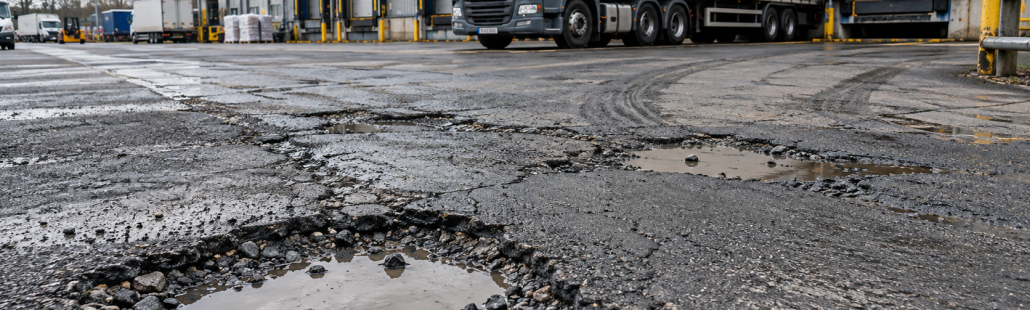
Addressing minor defects promptly prevents them from developing into deeper structural problems. Where isolated potholes form, professional pothole repairs can stabilise the area temporarily, but repeated failure suggests a need for structural reinforcement.
Designing Roads With Operational Realities in Mind
One of the most effective ways to prevent turning-related damage is to design road layouts that minimise extreme manoeuvres. Wider turning radii reduce torsional stress and improve traffic flow. Strategic layout planning also reduces congestion and concentrated loading.
Where tight turns are unavoidable, strengthening those areas during construction is essential. This may involve thicker surfacing layers or reinforced sub-base materials to withstand repeated stress.
Long-Term Cost Implications
Ignoring turning area stress often leads to a cycle of repeated maintenance. Surface patches may restore usability temporarily, but without addressing structural weakness, damage returns.
Investing in durable construction from the outset reduces long-term repair costs and minimises operational disruption. For commercial sites where access reliability is critical, proactive design is significantly more cost-effective than reactive maintenance.
Building Roads That Withstand Real-World Use
Vehicle turning areas are among the most demanding parts of any road network. They experience complex forces that straight sections do not. Understanding these stresses allows property owners and contractors to make informed design decisions.
By reinforcing high-stress zones, improving drainage and ensuring strong foundations, roads can withstand operational pressures more effectively. Designing with real-world vehicle movements in mind leads to longer-lasting, safer and more reliable surfaces.