
- min min
- No Comments
- January 16, 2026
How Heavy Vehicles Accelerate Road Wear in Industrial Areas
Industrial estates, logistics hubs, and commercial yards across the UK frequently experience premature road deterioration. In many cases, this decline is not due to poor workmanship but to the stresses imposed by heavy vehicles. HGVs, articulated lorries, refuse vehicles, and plant machinery place far greater loads on road surfaces than standard cars or vans. Over time, these loads accelerate wear, leading to cracking, deformation, and structural failure.
Heavy vehicle road damage UK site managers encounter is often progressive rather than sudden. Early warning signs may be subtle, but without intervention, damage compounds quickly. Understanding how vehicle weight and movement affect road construction is essential for making informed maintenance and resurfacing decisions.
The Relationship Between Vehicle Weight and Road Stress
Every road surface is designed with a specific load capacity in mind. When vehicles exceed or regularly approach that capacity, stress is transferred through the surface layers into the underlying structure. Heavy vehicles exert concentrated loads through relatively small contact areas at the tyre interface, creating high pressure on the surface.
Repeated loading causes fatigue within the asphalt or tarmac layer. Over time, the binder loses flexibility, micro-cracks form, and the surface begins to weaken. In industrial environments where heavy vehicles follow the same routes repeatedly, these stresses are intensified, particularly along wheel paths and turning areas.
Axle Loads and Their Impact on Surface Lifespan
It is not just the overall weight of a vehicle that matters but how that weight is distributed. Axle loads play a significant role in determining how much damage a vehicle causes. A fully laden HGV can exert several times the stress of a car, even if the number of vehicle movements is lower.
In heavy vehicle road damage UK assessments, axle loading is often identified as a primary factor in premature failure. Roads designed for light commercial use may cope initially, but sustained heavy axle loads accelerate cracking and deformation, especially if the surface thickness is inadequate.
Turning Movements and Shear Stress
Industrial sites rarely involve simple straight-line traffic. Vehicles are required to turn sharply into loading bays, manoeuvre in confined yards, and reverse into position. These movements generate shear forces that place additional strain on the surface.
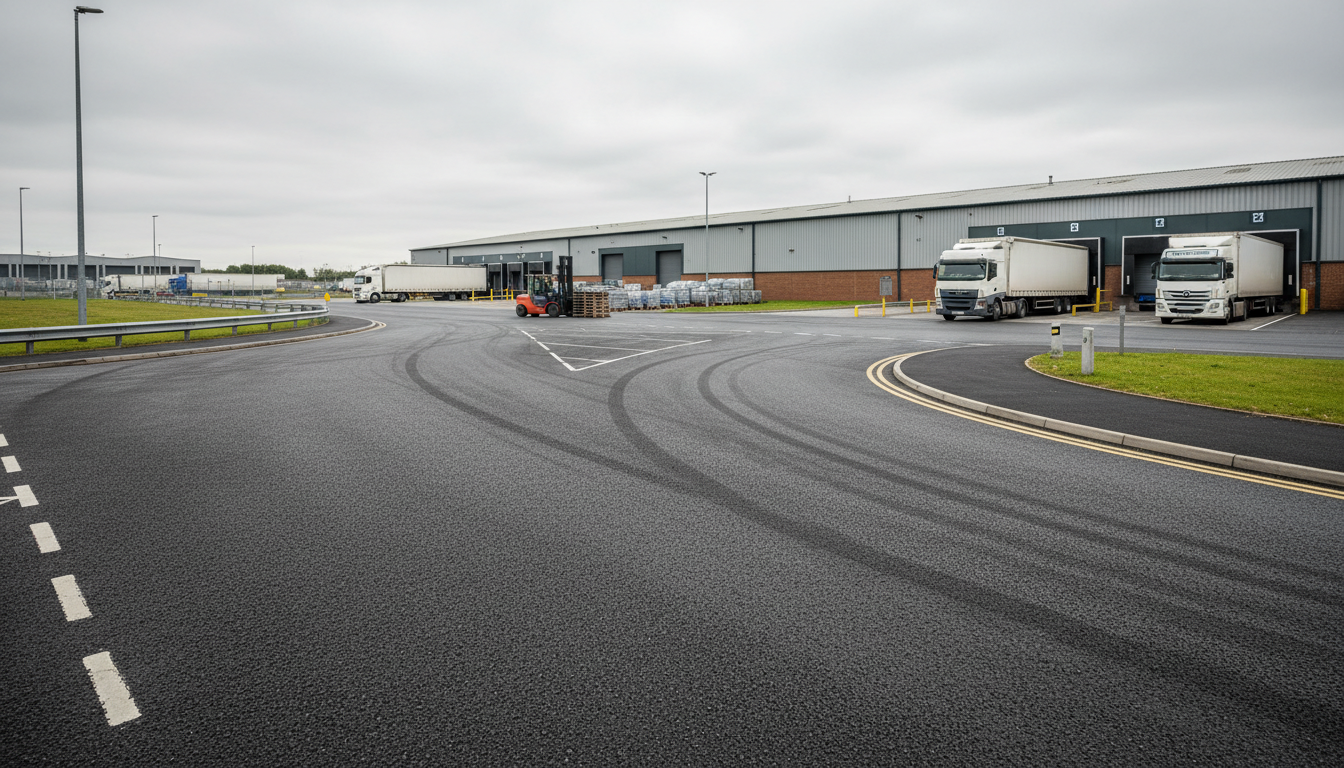
As vehicles turn, tyres twist against the road surface, pulling at the binder and aggregate. This action can cause scuffing, surface tearing, and early loss of material. In areas where turning is frequent, such as entrances and loading zones, surface wear progresses more rapidly than on straight sections of road.
Rutting and Surface Deformation
One of the most visible consequences of heavy vehicle road damage UK sites experience is rutting. Rutting appears as depressions in the wheel paths caused by permanent deformation of the surface or layers beneath. This issue is particularly common where heavy vehicles follow consistent routes.
Ruts not only indicate structural weakness but also create secondary problems. Water collects in depressions, increasing the risk of surface breakdown during freeze-thaw cycles. Over time, rutting can compromise drainage, accelerate cracking, and make driving conditions unsafe.
The Role of the Sub-Base in Heavy Vehicle Performance
While surface materials are often blamed for road failure, the condition and design of the sub-base are equally important. The sub-base distributes loads from the surface into the ground below. If it is too thin, poorly compacted, or unsuitable for heavy traffic, failure is inevitable.
In many cases of heavy vehicle road damage UK contractors investigate, surface repairs alone are insufficient because the underlying support has already deteriorated. Strengthening the sub-base during resurfacing works is often necessary to prevent repeated failure.
Water Ingress and Accelerated Structural Breakdown
Heavy vehicles do not damage roads in isolation. Water plays a critical supporting role in accelerating deterioration. Cracks created by load stress allow water to penetrate the surface. This moisture weakens the bond between layers and reduces the bearing capacity of the sub-base.
Once water is present, each passing heavy vehicle pumps moisture deeper into the structure, a process known as hydraulic action. This leads to rapid breakdown of the road layers, particularly during colder months when freeze-thaw cycles are common.
Why Patching Often Fails in Industrial Settings
When defects first appear, patching is often used as a cost-effective solution. However, in heavy-use environments, patch repairs are frequently short-lived. The surrounding surface continues to move under load, placing stress on the edges of the patch.
As a result, patched areas crack and break away, sometimes more quickly than the original surface. This is a common outcome in heavy vehicle road damage UK scenarios where patching is used repeatedly instead of addressing the underlying structural issues.
Professional pothole repairs remain appropriate for isolated defects, but widespread or recurring damage usually indicates the need for more comprehensive intervention.
Designing Roads for Heavy Vehicle Traffic
The most effective way to reduce heavy vehicle road damage UK sites experience is through correct design and specification. Roads intended for industrial use require thicker surface layers, stronger binders, and robust sub-base construction. These elements work together to distribute loads and resist deformation.
Material choice also plays a role. Dense asphalt mixes are often preferred for heavy-duty applications due to their strength and resistance to shear forces. Correct installation is essential to ensure compaction levels and layer thickness meet design requirements.
High-quality commercial surfacing ensures that industrial roads are built to withstand the demands placed upon them from the outset.
Installation Quality and Long-Term Performance
Even the best materials will fail if installation standards are poor. Inadequate preparation, insufficient compaction, or rushed curing can all reduce surface lifespan. Heavy vehicles quickly exploit weaknesses, turning minor defects into major failures.
Professional tarmac installation includes careful preparation of the base layers, precise laying techniques, and controlled compaction. These steps are critical in industrial settings where margins for error are small.
Maintenance Planning for Heavy Vehicle Routes
Proactive maintenance plays an important role in extending road lifespan. Regular inspections allow early identification of cracks, drainage issues, and surface deformation. Addressing these problems promptly helps prevent water ingress and structural damage.
For industrial sites, maintenance planning should focus on high-stress areas such as entrances, turning zones, and loading bays. These locations often require additional reinforcement or more frequent attention to maintain performance.
Financial Implications of Ignoring Heavy Vehicle Damage
Failing to account for heavy vehicle road damage UK businesses face can have significant financial consequences. Reactive repairs are often more expensive over time than planned resurfacing or structural upgrades. Repeated disruption to site operations also carries indirect costs, including downtime and restricted access.
Investing in durable road construction and timely maintenance reduces long-term expenditure and improves reliability. For many site managers, this approach provides better value than repeated short-term fixes.
Planning for Future Traffic Demands
Industrial sites often evolve, with changes in traffic volume, vehicle size, or operational layout. Roads designed for current use may become inadequate as demands increase. Forward planning allows surfaces to be specified with future requirements in mind, reducing the risk of premature failure.
Understanding how heavy vehicles accelerate wear enables better decision-making when upgrading or expanding industrial infrastructure.
Managing Road Wear in Industrial Environments
Heavy vehicle road damage UK sites encounter is a predictable outcome when surfaces are exposed to sustained high loads without appropriate design and maintenance. By recognising the causes of accelerated wear, property owners and site managers can take proactive steps to protect their assets.
Well-designed construction, professional installation, effective drainage, and timely maintenance all contribute to longer-lasting industrial roads. Addressing these factors together ensures safer access, reduced disruption, and improved value over the lifespan of the surface.