



- Minisgreat
- No Comments
- September 23, 2026
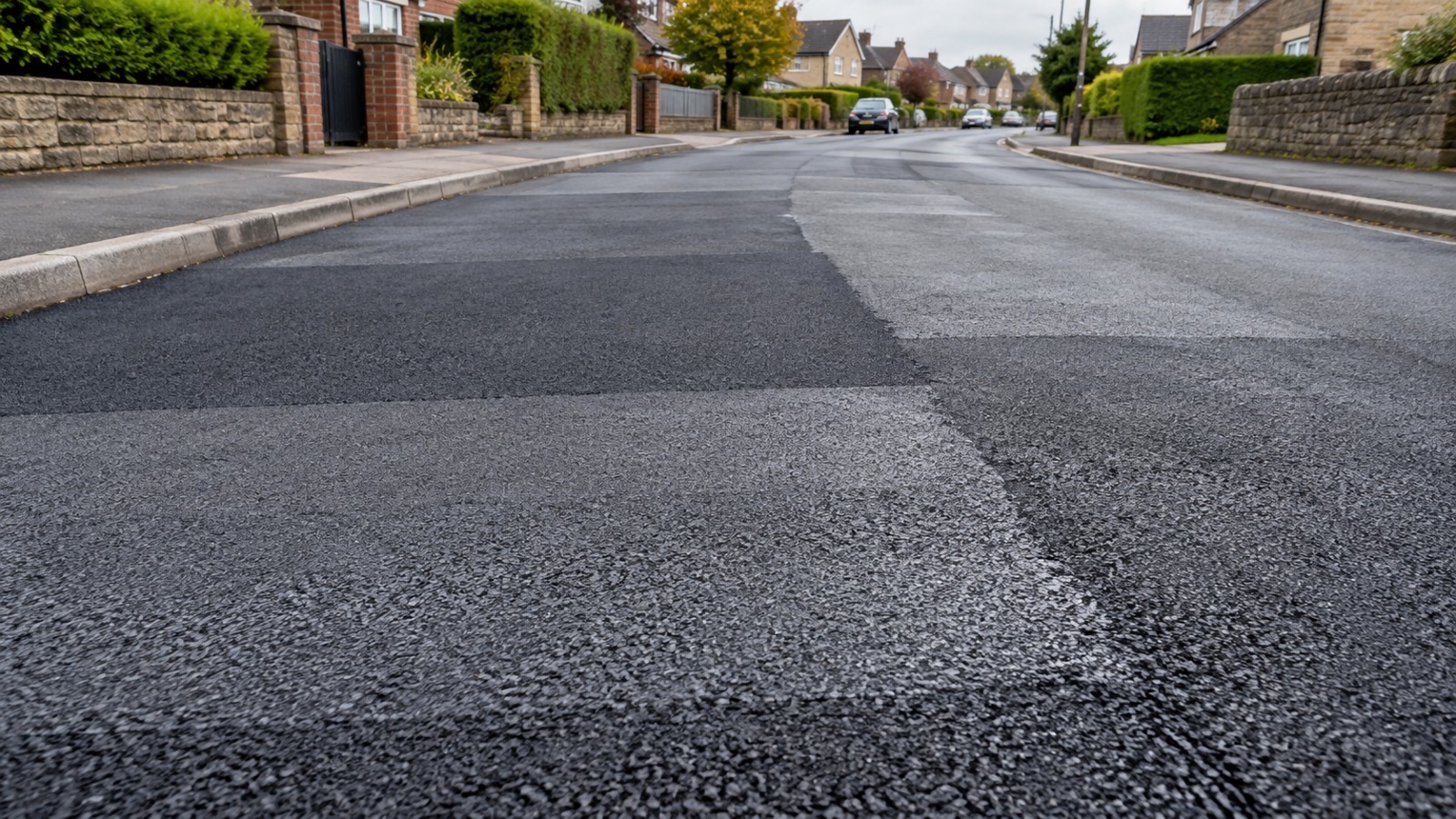
Fresh Tarmac Looking Patchy or Different Shades of Black
Having a driveway, access road or commercial area resurfaced creates an expectation of a smooth, completely black finish.
So when newly laid tarmac appears darker in some places and lighter in others, it can immediately raise concerns.
There may be obvious bands across the surface, darker areas around joints, patches that look slightly grey or sections that seem shinier than the rest. Viewed in certain light, the differences can be surprisingly noticeable.
The reassuring point is that colour variation does not automatically mean there is anything structurally wrong with the pavement.
Fresh asphalt is made from aggregate coated and bound with bituminous material, and its final appearance can be influenced by production, laying, compaction, temperature, weather, traffic and even the angle from which sunlight reaches the surface.
For property owners concerned about patchy new tarmac UK installations, the important question is not simply whether the road is one perfectly consistent shade of black. It is whether differences in appearance are purely visual or accompanied by physical defects.
Fresh Asphalt Is a Mixture of Different Materials
Tarmac may look like one uniform black substance from a distance, but the material has considerably more structure when viewed closely.
Aggregate forms much of the mixture, while bituminous binder coats and binds those particles together.
The dark appearance associated with newly installed asphalt comes largely from this binder.
As the surface is laid, compacted and subsequently exposed to weather and traffic, the amount of aggregate visible at the surface and the way light reflects from it can vary.
Even small differences can create noticeable changes in shade.
Professional tarmac installation is therefore better judged by the complete quality of the finished pavement than by expecting every square metre to look photographically identical.
New Tarmac Changes Appearance as It Ages
The appearance seen immediately after installation is not necessarily the appearance the road will retain.
Fresh asphalt is usually very dark.
Over time, exposure to weather and traffic changes the surface. Aggregate becomes more visible, dust and everyday road contamination affect its appearance, and the intense black associated with newly laid material gradually becomes less pronounced.
This weathering does not necessarily happen at exactly the same rate everywhere.
Some parts of a driveway may receive more direct sunlight. Other areas may remain shaded. Vehicle tyres may repeatedly travel across particular wheel paths while the edges receive almost no traffic.
The result can be temporary differences in colour as the pavement settles into normal use.
Temperature During Installation Can Affect Appearance
Asphalt needs to be transported, laid and compacted while it remains within appropriate working conditions.
It begins cooling from the moment it leaves production and continues losing heat during transport and placement.
Different parts of a project may therefore be at slightly different temperatures during the laying process.
This does not automatically indicate poor workmanship, but temperature influences how the material behaves during placement and compaction.
On a large surface, visual differences can sometimes correspond with different stages of the paving operation.
The important issue is whether the material has been properly installed and compacted rather than whether minor colour differences can be detected afterwards.
Compaction Can Change How the Surface Reflects Light
Two areas containing the same asphalt mixture can look slightly different depending on their surface texture.
Compaction affects that texture.
A smoother, more tightly finished area can reflect light differently from a section with a slightly more open-looking texture.
The result may be a visible difference in shade, particularly when the sun is low or the surface is viewed from a particular direction.
One section may appear deep black while another looks more grey, even though the material itself is essentially the same colour.
On larger projects, professional machine lay tarmac helps provide controlled placement across the area, although joints, edges and other details still require appropriate finishing and compaction.
Roller Marks Can Sometimes Create Temporary Visual Differences
Compaction equipment follows specific passes across newly laid asphalt.
Immediately afterwards, the surface can show subtle visual differences corresponding with those movements.
These may look like darker or lighter bands.
The effect can be particularly noticeable when the pavement is brand new and has not yet experienced normal traffic or weathering.
If the surface remains level, firmly compacted and consistent in texture, a visual band is not necessarily evidence of a defect.
Many appearance differences become considerably less noticeable once the road has been in service for a while.
Joints Can Look Darker Than the Main Surface
Large asphalt areas cannot always be laid as one completely uninterrupted section.
There may be construction joints where adjacent sections of material meet.
These locations can sometimes appear visually different from the surrounding surface.
The joint may be slightly darker or have a different texture, particularly shortly after installation.
What matters is how the joint has been constructed.
A visible line is not necessarily a failed joint. A joint that begins opening, cracking, losing aggregate or allowing water penetration is a different matter and deserves attention.
Appearance and performance should not be confused.
Hand-Finished Areas Can Look Different
Even when most of a road has been machine laid, certain areas may require additional hand work.
Corners, drainage covers, kerbs, restricted spaces and awkward edges cannot always be finished in exactly the same way as the open pavement.
These areas may consequently have a slightly different surface texture.
Because texture changes how light reflects, the colour can appear different too.
A small hand-finished area looking darker or lighter than the surrounding machine-laid asphalt does not automatically mean a different or inferior material has been used.
Different Batches Can Produce Subtle Colour Variations
Larger projects may require more than one delivery of asphalt.
Even when material is produced to the same specification, subtle visual differences can occur between loads.
Small changes in aggregate appearance, binder coating and surface texture can become noticeable after installation, particularly while the pavement is fresh.
The boundary between two loads may sometimes appear more obvious under certain lighting conditions.
This does not automatically mean one section is structurally inferior.
Performance depends on whether the materials meet the required specification and have been properly installed.
Why Some Areas Look Shinier Than Others
Shine can make one part of fresh tarmac appear significantly darker.
A smoother surface reflects light differently from a rougher one.
The presence of bituminous binder near the surface can also influence the initial appearance.
Tyres may then create additional darkening as vehicles begin using the pavement.
A shiny area should therefore be assessed in context.
If it is firm, level and stable, the difference may simply be visual. If it is unusually soft, sticky, smooth or deforming under ordinary traffic, further investigation may be appropriate.
Vehicle Tyres Quickly Change the Appearance
Once a newly surfaced road or driveway opens to traffic, it no longer wears uniformly.
Tyres follow predictable routes.
On a driveway, vehicles normally enter and leave along approximately the same wheel paths. In a commercial yard, delivery vehicles may repeatedly travel between an entrance and loading area.
Those wheel paths can darken or become visually smoother.
Turning movements can create even more noticeable marks because tyres scrub against the asphalt rather than simply rolling across it.
A newly surfaced area can therefore begin looking less uniform surprisingly quickly without suffering structural damage.
Stationary Steering Can Leave Dark Marks
Turning the steering wheel while a vehicle remains stationary places substantial localised force on the surface.
The tyre twists directly against the asphalt.
This can create dark curved marks, particularly on fresh tarmac and during warm weather.
Such marks can look alarming because they stand out strongly against an otherwise untouched surface.
Avoiding unnecessary stationary steering can reduce concentrated tyre scrub, especially while a new driveway is beginning normal service.
The vehicle can instead be allowed to move slightly while steering wherever practical and safe.
Rain Can Make Colour Differences Much More Obvious
A surface that looks relatively uniform when dry can appear dramatically different after rain.
Water changes the way light reflects from asphalt.
Smoother or denser sections may appear darker than surrounding areas, while shallow differences in texture can suddenly become obvious.
As the pavement dries, some sections may also retain moisture longer than others.
This can create temporary patchiness that disappears completely once the whole area has dried.
For that reason, colour comparisons are most useful when the pavement has been given time to dry evenly.
Shade and Sunlight Can Create an Optical Effect
The direction and intensity of light have a surprisingly large influence on the appearance of tarmac.
A road can look uniformly black when viewed from one direction and visibly patchy when viewed from another.
Low sunlight can highlight small variations in surface texture. Overcast conditions can make the same surface appear much more consistent.
Buildings, trees, fences and parked vehicles also create shaded areas that change how the pavement looks.
Before assuming there is a material difference, it is worth considering whether the apparent patchiness changes with lighting conditions.
Dust and Construction Traffic Can Affect Fresh Surfaces
A newly completed road does not exist in isolation.
Construction vehicles, surrounding soil and ongoing building work can introduce dust and fine material onto the pavement.
This contamination can make certain areas appear lighter.
Tyre paths may remain darker because passing vehicles remove or redistribute some of the dust, creating an even stronger contrast.
On active construction or commercial sites, this can make a perfectly sound new surface look much less uniform than it did immediately after installation.
Why Commercial Sites Can Show Colour Differences Quickly
Large commercial surfaces are exposed to intensive traffic patterns.
HGVs follow defined routes, loading areas receive repeated vehicle movements and turning points experience tyre scrub.
As a result, a new commercial surfacing project can begin developing different visual zones soon after opening.
The main HGV route may look darker than lightly used parking areas. Turning points can show tyre marks, while sheltered edges retain their original appearance for longer.
These differences can provide a surprisingly clear picture of how traffic actually moves through the site.
Patchiness Is More Concerning When the Texture Is Also Different
Colour alone is not usually enough to diagnose a surfacing problem.
Texture provides more useful information.
If a lighter area also looks unusually open, loose or poorly compacted, it deserves closer examination.
Likewise, a dark patch that is soft, excessively smooth or visibly moving under traffic is more significant than one that simply appears darker.
The question should therefore be whether the surface behaves differently, not just whether it looks different.
Loose Aggregate Is Different From Normal Colour Variation
A sound asphalt surface should not be confused with one that is actively losing material.
If aggregate is becoming loose in particular patches, the problem is no longer purely cosmetic.
Vehicle tyres may begin picking up particles and the affected area can gradually become rougher.
Continued material loss can eventually expose the pavement to further deterioration.
This is very different from harmless variations in shade across an otherwise firm and stable surface.
Depressions Can Appear Darker Even When the Material Is the Same
Sometimes a dark patch is actually a level problem.
A shallow depression may hold a very thin film of water after rainfall.
From a distance, this makes the area look much darker than the surrounding tarmac.
Once the water evaporates, the apparent colour difference disappears.
If the same patch repeatedly stays wet long after the rest of the surface has dried, checking the pavement level and drainage can help determine whether water is collecting there.
Soft Dark Areas Deserve More Attention
A dark patch that also feels unusually soft is more significant than a simple colour difference.
During hot weather, asphalt naturally becomes less stiff as pavement temperature rises. Certain areas may show tyre marking more clearly as a result.
However, persistent softness, displacement or material being picked up by tyres should not be dismissed as ordinary patchiness.
The pavement condition, material and traffic loading may need assessment.
Colour can be the first thing someone notices, but physical behaviour determines whether there is a genuine performance concern.
Cracks Are Not Normal Colour Variation
Fresh asphalt can display different shades without any structural problem.
Cracking is different.
If lines begin opening through a recently laid surface, especially if they follow cracks that existed in the previous pavement, movement may be occurring underneath.
Water can then enter those openings and contribute to further deterioration.
If the defect progresses to material loss, professional pothole repairs may eventually become necessary, although understanding the original cause remains important.
A colour difference should therefore be monitored differently from a physical break in the pavement.
Why Repairs Rarely Match Old Tarmac Perfectly
Patch repairs provide perhaps the clearest example of normal asphalt colour variation.
Fresh repair material is usually much darker than the older road surrounding it.
The contrast can be dramatic.
Over time, weathering reduces the difference, although a perfect visual match is not always achievable.
This is why a road containing several repairs can display multiple shades of grey and black while remaining entirely serviceable.
Age is one of the strongest influences on asphalt appearance.
Should New Tarmac Be Completely Jet Black?
Fresh tarmac is normally dark, but expecting a perfectly uniform jet-black appearance across every part of a large project can be unrealistic.
Asphalt is a functional construction material rather than a decorative coating.
Minor variations in aggregate, texture, compaction, lighting and weathering can all influence how it appears.
The better indicators of installation quality include appropriate levels, drainage, compaction, stability, joints and overall surface condition.
A pavement should ultimately be judged by how it performs as well as how it looks.
When Should Patchiness Be Investigated?
Visual variation becomes more important when it occurs alongside physical changes.
Areas that remain unusually soft, begin deforming under ordinary vehicles, lose aggregate, crack or retain standing water deserve closer attention.
Rapidly worsening differences are also more significant than stable colour variations.
Photographs can be useful for monitoring a new surface over time.
Taking pictures from approximately the same position and under similar conditions makes it easier to determine whether a patch is actually changing or simply looks different because of lighting and moisture.
Fresh Tarmac Usually Becomes More Visually Consistent With Time
One of the most important things to remember about patchy new tarmac UK property owners notice is that a freshly completed surface has not yet experienced normal ageing.
Traffic has not worn across it evenly. Sunlight and rainfall have not weathered the binder. Dust and everyday use have not created the more familiar appearance of an established road.
As weeks and months pass, many minor colour differences become less noticeable.
That does not mean every unusual patch should be ignored. Physical defects such as cracking, deformation, loose material or persistent drainage problems need to be distinguished from harmless differences in shade.
Fresh asphalt does not need to resemble a perfectly uniform coat of black paint to perform properly.
If the pavement is stable, correctly formed and structurally sound, subtle differences between darker and lighter areas can simply be part of how newly laid tarmac looks before traffic, weather and time gradually change the surface.


