
- Minisgreat
- No Comments
- September 19, 2026
Why Tarmac Starts Crumbling at the Edges
When a tarmac driveway, access road or car park begins deteriorating, the first signs do not always appear in the centre of the surface.
Quite often, the trouble starts around the edges.
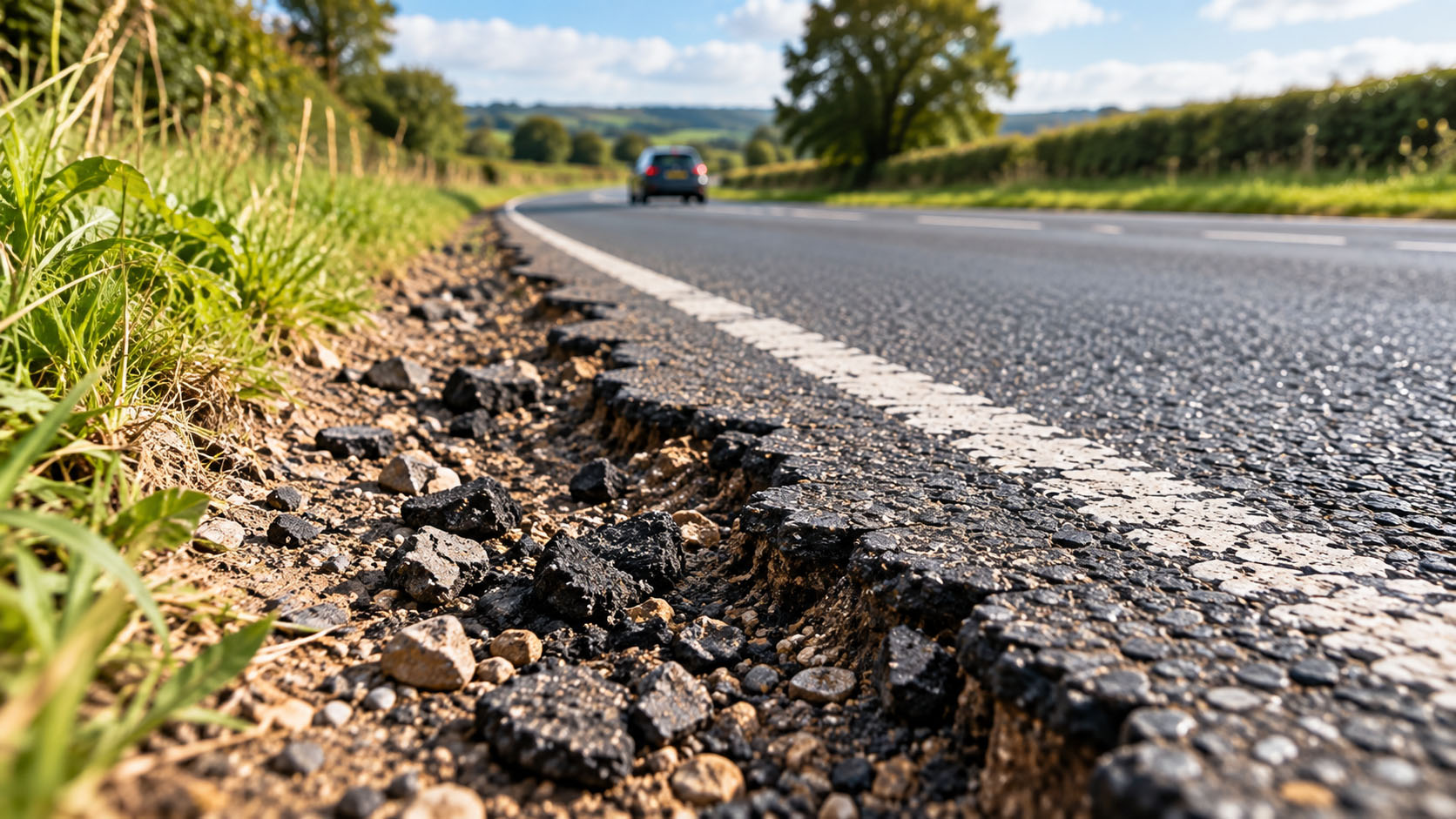
A previously neat asphalt boundary can begin looking rough. Small pieces of material loosen, cracks develop parallel to the edge and sections gradually break away. What starts as a narrow damaged strip can eventually work further into the road.
There is a straightforward reason why this part of the pavement is vulnerable.
The centre of an asphalt surface is surrounded and supported by more pavement. At the outer edge, that continuous support ends. If the edge has not been properly constructed, restrained or protected from traffic and water, it can become one of the weakest parts of the entire surface.
For anyone noticing tarmac crumbling at edges UK roads and driveways can provide several possible explanations, and understanding the cause is important before deciding how the area should be repaired.
Tarmac Needs Support at Its Boundaries
Asphalt performs as part of a complete pavement structure.
The visible surface is supported by layers underneath it, while the surrounding pavement helps provide stability across the area.
At an exposed edge, conditions are different.
There is no asphalt immediately beyond the boundary. Depending on the construction, there may instead be soil, grass, gravel or another material at a lower level.
If vehicles travel too close to an inadequately supported edge, the asphalt can be subjected to forces it was not designed to withstand.
Correct tarmac installation therefore requires attention to boundaries as well as the main body of the pavement.
Poor Edge Support Can Lead to Cracking
Imagine repeatedly driving a vehicle over the edge of a rigid board that is properly supported in the centre but poorly supported around its perimeter.
The unsupported section experiences greater stress.
A road edge can behave in a similar way.
If the foundation underneath the outer part of the asphalt is inadequate or the surrounding ground has fallen away, tyres passing near the boundary can cause local movement.
Initially, the surface may flex without obvious damage.
Repeated loading can eventually create cracks.
Once the edge is cracked, it becomes much easier for small sections to break away.
Why Vehicle Tyres Cause So Much Damage Near the Edge
The position of vehicle tyres matters.
On a wide road, most vehicles remain comfortably away from the pavement boundary. Narrow access roads and driveways can be very different.
Drivers may regularly place one wheel close to the edge when passing another vehicle, turning through a gateway or manoeuvring around parked cars.
Delivery vans and HGVs can create particularly demanding loads.
If the same wheel path repeatedly runs along the outer section of the pavement, deterioration can become concentrated there even while the centre remains in good condition.
Heavy Vehicles Can Accelerate Edge Breakdown
Commercial access roads face an additional challenge because vehicle weights can be substantial.
HGVs, refuse vehicles, delivery lorries and plant can place far greater loads on pavement edges than ordinary cars.
A heavy vehicle does not necessarily need to drive completely off the tarmac to cause damage. Travelling with a wheel very close to an unsupported boundary may be enough to increase stress significantly.
This is why professional commercial surfacing should consider vehicle width, turning movements and likely wheel paths when the pavement is designed.
The way traffic uses a road can be just as important as the total number of vehicles.
Tight Entrances Put Tarmac Edges Under Extra Pressure
Gateways and entrances are common locations for edge deterioration.
Vehicles frequently need to turn while crossing these areas.
As tyres change direction, they introduce lateral forces into the surface rather than simply rolling forwards.
Large vehicles make the situation more demanding because their rear wheels can follow a tighter path than the front wheels.
The result is that an HGV entering a narrow site may repeatedly run its rear tyres very close to the inside edge of the tarmac.
Over time, that concentrated loading can contribute to cracking and crumbling.
Missing Edge Restraint Can Make the Problem Worse
Some asphalt areas benefit from a suitable physical boundary or supporting detail at the edge.
Kerbs are a familiar example.
A properly constructed kerb line can provide a defined boundary and help protect the pavement edge from surrounding ground movement and vehicle overrun.
Not every asphalt surface requires the same edge treatment, but an exposed boundary needs to be designed appropriately for its use.
Simply allowing asphalt to taper into soft ground can create a vulnerable area, particularly where vehicles regularly travel close to it.
The Foundation Must Extend Properly Beneath the Edge
One important problem is hidden after the surface has been laid.
The supporting foundation needs to provide adequate support beneath the full pavement, including its outer sections.
If the sub-base becomes thinner or poorly compacted towards the edge, the asphalt above may not receive the same support as the centre.
The finished surface can initially look completely normal.
Once vehicles begin using it, however, the weaker outer area can start moving.
Cracks may form along the boundary before pieces of asphalt begin separating.
Water Can Wash Away Support
Drainage is another major factor in edge failure.
Road edges are often exposed to water flowing from the pavement onto surrounding ground.
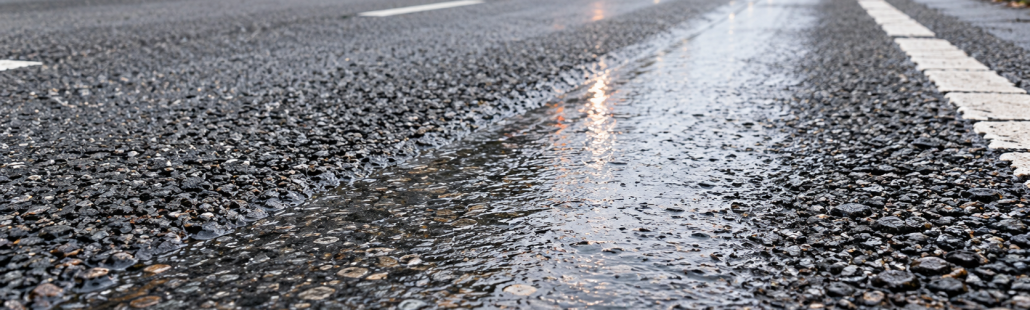
If drainage has not been properly considered, runoff can erode material beside the asphalt.
Gradually, the supporting ground around the edge may wash away.
The tarmac can then become partially unsupported.
Traffic continues loading the area from above, and the weakened edge begins cracking or collapsing.
What appears to be a problem with the asphalt may therefore have started with erosion immediately beside it.
A Small Drop Beside the Road Can Become a Big Problem
A difference in level between the asphalt and surrounding verge may not initially appear serious.
Over time, however, a pronounced drop can leave the pavement edge vulnerable.
Vehicle tyres that accidentally leave the asphalt can strike the edge when returning to the road.
That impact can damage the surface.
Repeated vehicle movements can also disturb the ground immediately alongside the pavement, reducing lateral support even further.
Once the boundary begins breaking down, the level difference can become larger and the deterioration can accelerate.
Cracks Let More Water Into the Pavement
Edge cracking creates another route for rainwater.
Once a crack opens, moisture can penetrate below the asphalt.
If the supporting materials become saturated or begin moving, the pavement can lose stability.
Traffic then continues applying pressure.
The crack widens, small pieces loosen and the boundary starts becoming irregular.
This creates a damaging cycle in which edge movement causes cracking, cracking allows water ingress and water contributes to further movement.
Frost Can Worsen Existing Edge Damage
British winter conditions can place additional stress on pavement that is already deteriorating.
Where water has entered cracks and surrounding materials, cold conditions can contribute to further disruption.
The key issue is that damaged edges provide easier routes for moisture than an intact, well-supported pavement.
A minor defect that survives the summer may therefore become much more noticeable after a wet winter.
This is one reason early edge deterioration is worth addressing before large sections begin breaking away.
Poor Compaction Near the Boundary Can Create Weak Areas
Asphalt needs appropriate compaction after it is laid.
Achieving consistent compaction across the open centre of a road can be easier than working close to kerbs, walls, drainage structures and irregular boundaries.
If the outer section receives inadequate compaction, it can become less durable than the rest of the pavement.
The weakness may not be visible when the road is new.
Repeated traffic and weather exposure can gradually reveal it.
Professional machine lay tarmac can provide controlled placement across larger areas, but careful finishing and compaction around boundaries remain essential.
Thin Asphalt at the Edge Can Fail Earlier
Thickness can also vary if the underlying levels have not been prepared properly.
If the asphalt becomes thinner towards the outer boundary, that area may have less capacity to withstand traffic loading.
Combine inadequate thickness with weak support underneath and the likelihood of deterioration increases further.
The surface can begin cracking under vehicle tyres before gradually breaking into smaller pieces.
This is why good preparation needs to establish appropriate levels before the asphalt is placed.
Why Crumbling Often Looks Worse Than a Normal Crack
A crack is initially a relatively narrow separation within the pavement.
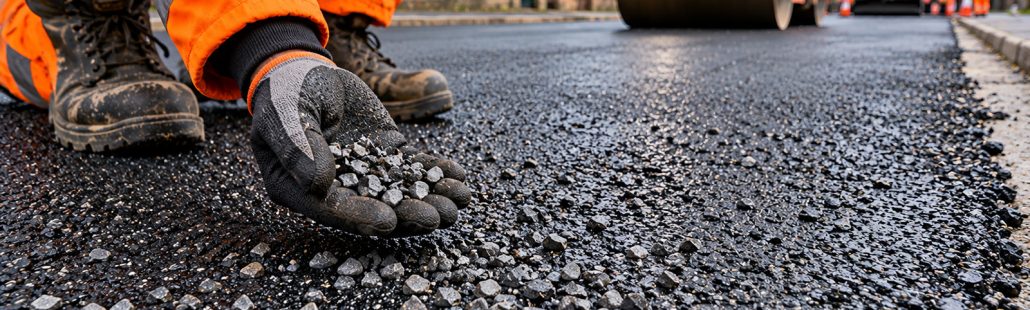
Crumbling indicates that pieces of material are beginning to detach.
At an exposed edge, once the asphalt starts breaking apart there is nothing beyond it to contain the loose material.
Vehicle tyres can dislodge pieces, while rainwater can enter the newly exposed areas.
The edge progressively retreats.
This makes edge deterioration capable of expanding more visibly than an isolated crack in the middle of a road.
Grass Verges Can Hide Developing Problems
Roads bordered by grass can appear well supported because vegetation grows directly alongside the asphalt.
The appearance can be misleading.
Soft soil beneath the grass may not provide meaningful structural support to the pavement.
Heavy rain can erode the ground, while vehicle tyres running onto the verge can compress or displace it.
The asphalt edge can eventually be left projecting above softer surrounding material.
By the time visible crumbling begins, support beside the pavement may already have been reduced substantially.
Gravel Beside Tarmac Can Move Away From the Edge
Gravel boundaries present a different issue.
Loose stone can migrate under vehicle tyres, maintenance activities and rainfall.
If material directly beside the asphalt is repeatedly displaced, a small gap or level difference can develop.
Drivers turning onto or off the tarmac can then place additional force on the exposed edge.
Good detailing and maintenance around the transition help prevent the boundary from gradually losing support.
Drainage Channels and Kerbs Need Careful Detailing
Not all edge failures occur beside soil or gravel.
Asphalt can also deteriorate where it meets concrete kerbs, channels and other fixed structures.
These materials behave differently from flexible asphalt.
If the joint opens, water can enter. If the asphalt is inadequately compacted alongside the rigid structure, movement can begin under traffic.
The visible result may be a narrow crumbling strip following the kerb or drainage channel.
Although it appears to be edge failure, the problem may involve the interface between two different pavement materials.
Why Patching the Broken Edge Doesn’t Always Last
When an asphalt edge has crumbled away, replacing the missing material seems like an obvious repair.
That can be effective when the surrounding pavement and foundation remain sound.
However, simply adding fresh asphalt against a weak edge will not necessarily correct the reason it failed.
If the sub-base underneath has disappeared, the repair still lacks support.
If vehicles continue overrunning the boundary, the new material remains exposed to the same loading.
If water is eroding the verge, deterioration can start again.
A lasting repair therefore needs to consider the surrounding construction.
Edge Damage Can Eventually Become a Pothole
Once the pavement starts losing material, the defect can work progressively inwards.
Vehicle tyres strike the broken area, more asphalt becomes loose and water reaches deeper into the construction.
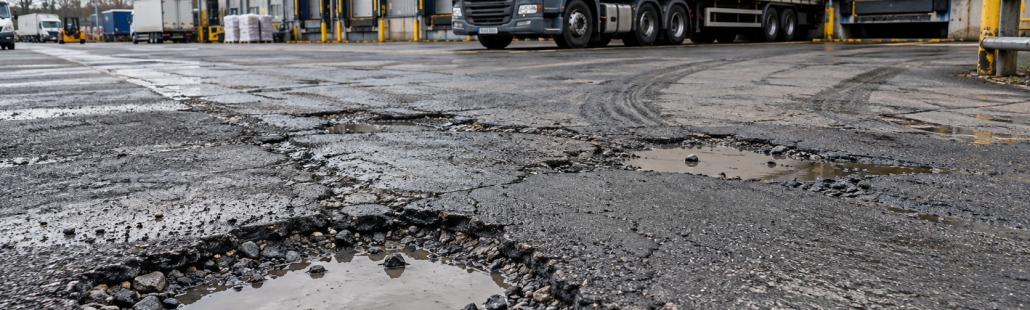
Eventually, the damaged section can resemble a pothole extending from the side of the road.
At this stage, appropriate pothole repairs may require cutting back to sound material and restoring adequate support before the asphalt is replaced.
Simply filling the irregular hole without addressing an unstable edge can lead to repeated failure.
Why Narrow Roads Are Particularly Vulnerable
A wide carriageway gives drivers more room to keep their wheels away from the edges.
A narrow private or commercial road offers less flexibility.
When vehicles meet, one or both drivers may move towards the pavement boundary.
This can result in regular edge loading that was not obvious when the road was designed.
Large delivery vehicles can make the problem more pronounced.
If road widening is impractical, the existing edges may require particularly robust construction and ongoing inspection.
Commercial Yards Can Develop Similar Problems
Edge deterioration is not limited to traditional roads.
Large car parks and industrial yards can experience crumbling around islands, loading areas, concrete slabs and perimeter boundaries.
HGV manoeuvring is often responsible for concentrating loads in these areas.
A tyre may repeatedly track over the same corner while a vehicle turns towards a loading bay.
The centre of the yard can remain in excellent condition while a small number of heavily loaded edge areas deteriorate quickly.
Understanding actual traffic movements helps explain why the damage is so localised.
Early Repairs Can Prevent the Damage Spreading
A small edge crack is generally easier to deal with than a section where substantial material has disappeared.
Early investigation can establish whether the problem is confined to the asphalt or whether the supporting construction also requires attention.
Drainage and surrounding levels can be checked at the same time.
The objective should be to prevent the boundary from continuing to retreat.
Once the damage extends into regular wheel paths, repairs can become more disruptive because a larger section of pavement may need reconstruction.
Not Every Rough Edge Means the Road Is Failing
Some asphalt boundaries naturally have a less uniform appearance than the main surface.
Appearance alone does not establish structural failure.
The more important signs are changes over time.
An edge that is progressively cracking, losing pieces, sinking or developing a gap beside the surrounding ground deserves more attention than one that has remained stable for years.
Persistent standing water or obvious vehicle overrun can provide further clues about the cause.
Monitoring the area makes it easier to distinguish cosmetic irregularity from active deterioration.
Strong Tarmac Depends on What Happens at the Edge
The centre of a road receives most of the attention because it carries most of the traffic, but pavement performance can depend just as heavily on the details around its boundaries.
Tarmac crumbling at edges UK property owners notice is often linked to inadequate support, weak foundations, poor compaction, water erosion or repeated vehicle loading close to the pavement boundary.
Once the edge cracks, the deterioration can become self-reinforcing. Water gains access, loose material breaks away and tyres place increasing stress on what remains.
The most effective approach is therefore not simply to replace the pieces that have disappeared.
The edge needs stable support underneath it, appropriate protection or restraint where required, effective drainage and a construction capable of handling the vehicles using the road.
When those details are considered from the beginning, the boundary can remain as dependable as the rest of the pavement rather than becoming the place where deterioration starts.