
- Minisgreat
- No Comments
- October 10, 2026
Why Does New Tarmac Sometimes Feel Sticky Under Your Shoes?
You have just had a new driveway, access road or car park surfaced. The finish looks smooth, dark and professionally installed.
But when you walk across it, something feels unusual.
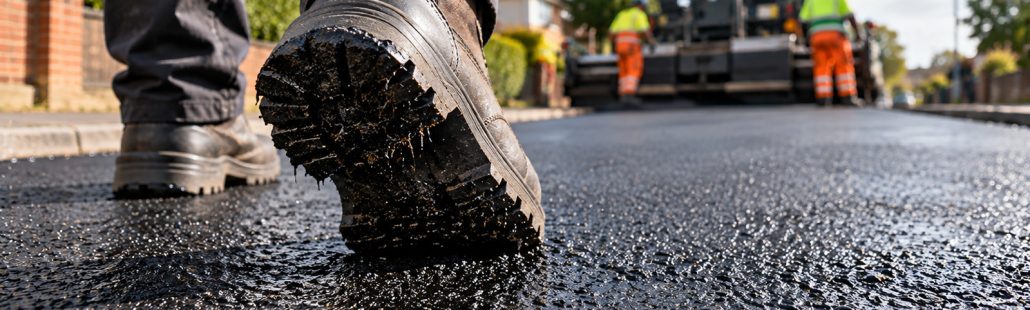
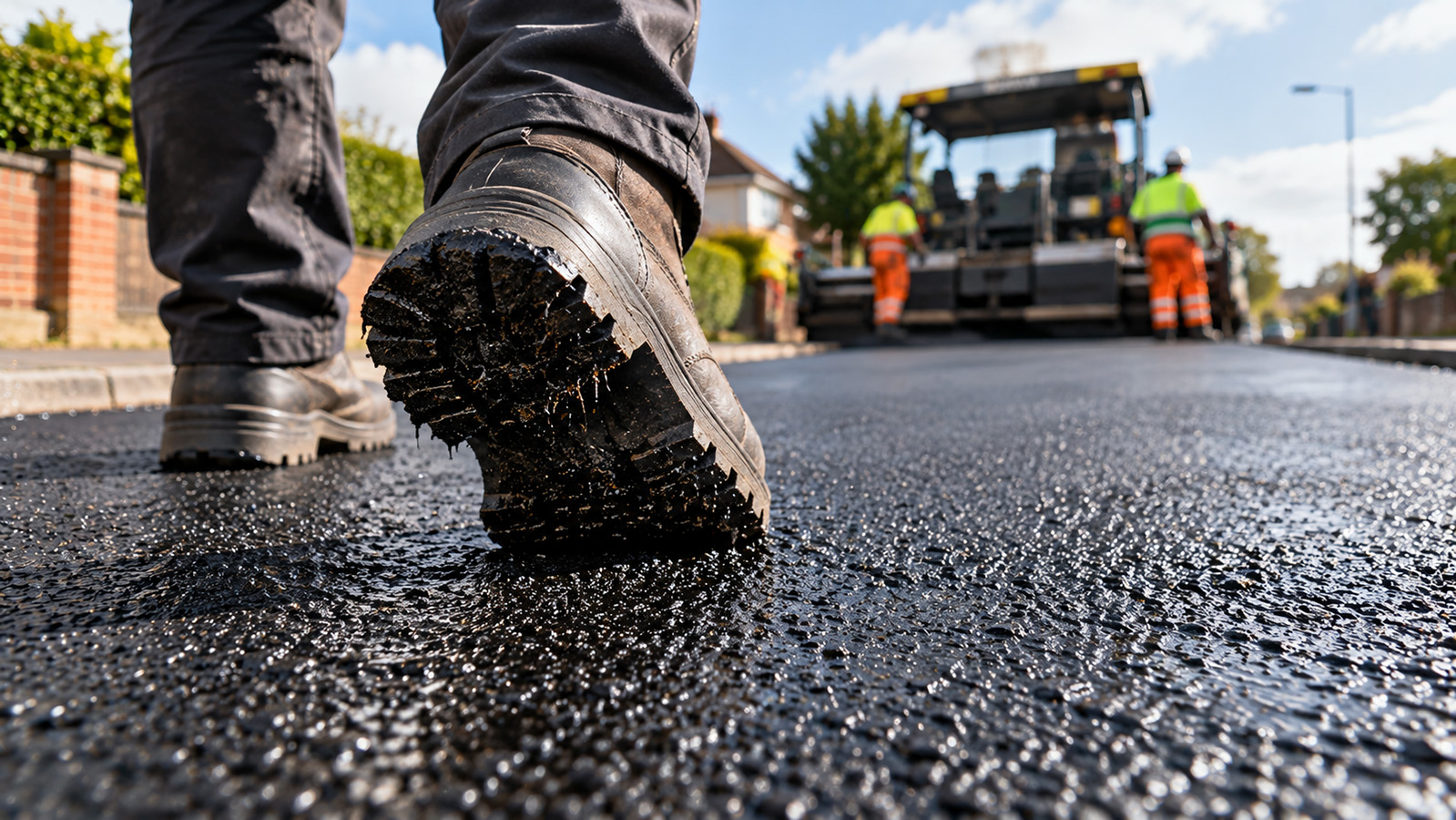
Your shoes seem to grip the surface more than expected. In some areas, there may even be a slight tacky sensation beneath your feet.
For property owners, this can raise an obvious question: is the new tarmac supposed to feel sticky?
In many cases, a slight tackiness shortly after installation can be explained by the materials used in asphalt construction, the temperature of the surface and the time that has passed since the work was completed.
However, there is an important difference between a newly laid surface that feels slightly tacky and one that remains excessively soft, transfers black material onto shoes or begins deforming under normal use.
Understanding why new tarmac feels sticky helps property owners recognise what may be part of the early life of a new surface and what deserves further investigation.
What Actually Makes Tarmac Stick Together?
To understand the sticky feeling, it helps to know what modern tarmac is made from.
Although the term tarmac is widely used throughout the UK, most modern roads, driveways and car parks are surfaced using asphalt mixtures.
These mixtures contain mineral aggregate held together by a bituminous binder.
The aggregate provides much of the structure and strength, while the bitumen coats and binds the particles together.
Bitumen is a dark, viscous material derived from petroleum refining.
Its properties change with temperature, which is essential to the way asphalt is manufactured, transported and installed.
When heated, the binder becomes less viscous, allowing the asphalt mixture to be worked and compacted.
As the material cools, the binder becomes stiffer and the asphalt develops the characteristics needed for normal use.
This temperature-sensitive behaviour is one of the main reasons freshly laid tarmac can sometimes feel different from an established road surface.
Fresh Asphalt Needs Time to Cool
One of the most common explanations for a sticky-feeling surface is that the asphalt is still warm.
Hot-mix asphalt is manufactured and delivered at elevated temperatures so that it remains workable during installation.
Once the material has been laid and compacted, it begins cooling towards the surrounding temperature.
During this period, the binder is still warmer and less stiff than it will be once the surface has cooled sufficiently.
If someone walks across the asphalt too soon, the surface may feel unusually soft or tacky.
Why Cooling Time Varies
There is no single cooling period that applies to every asphalt installation.
The time required depends on several factors, including the thickness of the material, the temperature at which it was laid, weather conditions and the type of asphalt mixture.
A thin surface course may cool differently from a thicker asphalt layer.
Warm summer conditions can also slow cooling compared with cooler weather.
The contractor should therefore determine when the finished surface is suitable for pedestrian and vehicle access rather than relying on a universal waiting period.
Professional tarmac installation includes consideration of these practical factors so that the newly laid surface can be opened to use at an appropriate time.
Why Does Tarmac Feel Stickier on Warm Days?
Even after asphalt has cooled following installation, temperature continues to influence the behaviour of its bituminous binder.
On warm days, the surface can become significantly hotter than the surrounding air.
Dark asphalt absorbs solar radiation efficiently, particularly when exposed to direct sunlight.
As the surface temperature increases, the bitumen becomes less stiff.
This does not mean that a correctly installed road should turn soft or sticky whenever the weather is warm.
However, temperature changes can make certain surface characteristics more noticeable, especially during the early life of the pavement.
The Difference Between Air Temperature and Surface Temperature
A common misunderstanding is that asphalt only becomes warm when the air temperature is exceptionally high.
In reality, the road surface can reach temperatures considerably above the surrounding air.
A sunny day with relatively moderate air temperatures may still produce a noticeably warm asphalt surface.
This is particularly relevant to exposed driveways and car parks with little shade.
A newly laid black surface can absorb considerable solar energy, making it feel warmer and potentially more tacky than expected.
Does New Tarmac Need to Cure?
The word curing is often used when discussing newly installed driveways.
However, it can be misleading when applied to conventional hot-mix asphalt.
Unlike concrete, which develops strength through cement hydration, hot-mix asphalt primarily becomes ready for use as it cools and its binder stiffens.
It does not require the same chemical curing process as concrete.
That said, a new asphalt surface can continue changing in appearance and surface characteristics as it experiences traffic, weather and gradual ageing.
These longer-term changes should not be confused with the initial cooling process.
A correctly specified and installed asphalt surface should not remain excessively sticky for weeks simply because it is supposedly still curing.
Why Do Some New Surfaces Look Shiny?
Freshly laid asphalt often appears darker and more reflective than an older road.
This is partly because the aggregate is coated with relatively fresh bituminous binder.
Depending on the asphalt mixture, installation conditions and surface texture, some areas may appear shinier than others.
A dark or slightly shiny appearance does not automatically indicate a problem.
However, excessive binder visible at the surface can sometimes be associated with a condition known as bleeding or flushing.
This is different from the normal appearance of freshly installed asphalt.
What Is Bitumen Bleeding?
Bitumen bleeding occurs when excess binder becomes present at the road surface.
Rather than the aggregate providing the intended surface texture, a noticeable film of binder can develop.
Affected areas may look unusually black, glossy or smooth.
In warm conditions, they may also feel tacky.
Bleeding can occur for several reasons, including an unsuitable mixture composition, excessive binder or other issues affecting the pavement.
The condition matters because excessive binder at the surface can reduce texture and potentially affect skid resistance.
How to Recognise Possible Bleeding
A newly laid surface may naturally look dark, but persistent glossy patches deserve closer attention.
If particular areas remain noticeably sticky after the asphalt has cooled, or black material transfers onto footwear, there may be more happening than ordinary early-life surface behaviour.
A professional assessment can help establish whether the appearance is normal for the specified mixture or indicates excessive binder at the surface.
It is important not to assume that every shiny patch represents bleeding.
The condition needs to be considered alongside the material specification, installation history and actual surface performance.
Can Poor Compaction Cause Sticky Tarmac?
Compaction is essential to the performance of asphalt.
During installation, rollers or other appropriate equipment are used to compact the material while it remains sufficiently workable.
Correct compaction helps achieve the intended density and reduces excessive air voids within the mixture.
Poor compaction can contribute to premature deterioration, deformation and other performance problems.
However, a sticky sensation underfoot is not, by itself, reliable evidence of inadequate compaction.
Tackiness is more directly associated with binder characteristics and temperature.
The distinction matters because different defects require different solutions.
For larger installations, professional machine lay tarmac can help achieve controlled placement and consistent thickness, while suitable rolling procedures remain essential for the finished pavement.
Why Do Shoes Sometimes Leave Marks on New Tarmac?
A newly installed asphalt surface may be more vulnerable to marking if it is used before it has cooled sufficiently.
Concentrated pressure from footwear can sometimes leave temporary impressions in material that remains warm and relatively soft.
The effect can be particularly noticeable with narrow heels or footwear that concentrates weight over a small contact area.
Ordinary walking should not cause significant permanent deformation once a correctly installed surface has cooled and is ready for use.
If clearly visible footprints continue appearing under normal conditions, the surface should be assessed.
Persistent softness can indicate that the asphalt is not performing as expected.
Why Can Car Tyres Leave Marks on Fresh Asphalt?
Tyres can apply greater and more concentrated forces than ordinary pedestrian traffic.
This is especially true when vehicles turn their steering wheels while stationary.
The tyre remains pressed against the pavement while being twisted across the surface, creating substantial localised stress.
On newly laid asphalt, particularly while it is still warm, these forces can produce scuffing or visible marks.
Stationary Steering Is Particularly Demanding
A car travelling forwards generally allows its tyres to roll across the surface.
When the driver turns the steering wheel without moving, the tyre effectively scrubs against the same small area.
This can disturb the surface of asphalt that has not yet cooled sufficiently or is otherwise susceptible to deformation.
Avoiding unnecessary stationary steering during the early period after installation can help reduce the risk of marking.
However, a properly constructed driveway should ultimately be suitable for normal vehicle manoeuvring.
Is Sticky Tarmac More Common on Driveways Than Roads?
The issue can be more noticeable on private driveways because people interact with the surface differently.
On a public road, drivers generally remain inside their vehicles.
On a driveway, homeowners walk across the surface, park vehicles, turn wheels and inspect the finish closely.
A slight difference in texture or tackiness that would go unnoticed on a road can become immediately apparent underfoot.
Driveways may also experience concentrated loads in the same parking positions.
Nevertheless, the underlying principles of asphalt performance remain similar.
The surface must be suitable for its intended use, supported by an appropriate foundation and installed using the correct methods.
Does the Type of Asphalt Make a Difference?
Not every asphalt mixture has identical characteristics.
Different mixtures are designed for different applications, traffic conditions and performance requirements.
The type of aggregate, binder grade, mixture composition and intended layer all influence how the material behaves.
An asphalt specified for a lightly trafficked domestic driveway may differ from one selected for a heavily used commercial access road.
This is why the correct material should be chosen according to the demands of the site.
Professional commercial surfacing needs to consider loading, turning movements, braking forces and environmental exposure rather than simply the appearance of the finished surface.
Can Rain Make New Tarmac Sticky?
Rain does not normally make correctly installed and cooled hot-mix asphalt sticky.
Water may temporarily change how the surface looks, particularly by making it appear darker or more reflective.
However, ordinary rainfall should not cause the bituminous binder to become tacky.
If a surface seems sticky after rain, other factors may be involved, including contamination or the condition of the binder at the surface.
Water can still create serious problems where drainage is poor or the pavement contains defects, but those issues are different from ordinary surface tackiness.
Should You Put Sand on Sticky Tarmac?
Property owners sometimes consider spreading sand over a sticky area to prevent material transferring onto shoes.
Although this may seem like a simple solution, it should not be attempted without understanding the cause.
Adding loose material can change the appearance of the surface and may create additional problems if the underlying issue remains unresolved.
If the asphalt is still cooling, the correct approach may simply be to keep traffic off it until the contractor confirms that it is ready.
If excessive binder is present, the appropriate treatment depends on the condition and specification of the pavement.
A contractor should assess persistent tackiness before any remedial material is applied.
When Should Sticky Tarmac Be Investigated?
A slight tacky sensation immediately after installation is not necessarily a reason for concern.
However, certain symptoms deserve further investigation.
A surface that remains excessively soft after cooling, develops persistent glossy patches, transfers significant black material onto shoes or deforms under ordinary use may not be behaving as intended.
The same applies where vehicle tyres repeatedly leave deep marks or where the surface begins moving under relatively modest loads.
These symptoms should be assessed in context.
The age of the asphalt, recent weather, mixture type and location of the affected areas can all help identify the cause.
What Should Property Owners Do After New Tarmac Is Laid?
The most important step is to follow the contractor’s instructions about when the surface can be used.
Access arrangements should reflect the particular asphalt mixture, installation conditions and site requirements.
Allowing the material to cool sufficiently helps reduce the risk of early marking or disturbance.
During the initial period, it is also sensible to avoid unnecessary concentrated loads or aggressive vehicle manoeuvres until the contractor has confirmed that normal use is appropriate.
If unusual softness or tackiness persists, the contractor should be contacted rather than attempting an improvised repair.
A Sticky Feeling Does Not Always Mean Poor Workmanship
It is understandable to question a new driveway when the surface feels different from an established road.
However, fresh asphalt and older asphalt do not always behave or look identical.
The temperature-sensitive properties of bitumen explain why newly installed material can feel slightly tacky, particularly before it has cooled fully.
A dark appearance, temporary warmth or minor early-life surface differences do not automatically indicate defective installation.
The concern arises when the surface remains excessively soft or develops persistent symptoms that interfere with normal use.
Understanding What Is Normal for New Tarmac
When new tarmac feels sticky under your shoes, the explanation is often connected to the bituminous binder and the temperature of the surface.
Fresh asphalt is installed hot, and its properties change as it cools. Warm weather can also influence how the binder behaves, especially on dark surfaces exposed to direct sunlight.
However, a properly installed asphalt surface should become suitable for its intended use once it has cooled sufficiently.
Persistent stickiness, excessive binder at the surface or repeated deformation should not simply be dismissed as part of a lengthy curing process.
The key is distinguishing normal early-life behaviour from signs that the material or installation may require closer examination.
A surface that has been correctly specified, laid and compacted should provide a stable, durable finish without remaining noticeably sticky during ordinary use.