

- min min
- No Comments
- May 4, 2026
The Hidden Cost of ‘Patchwork Repairs’ on UK Roads
When a pothole appears or cracking begins to spread, the quickest solution is often a localised patch. For many property owners and site managers, patching feels like the most cost-effective option. It is fast, relatively inexpensive upfront and causes minimal disruption.
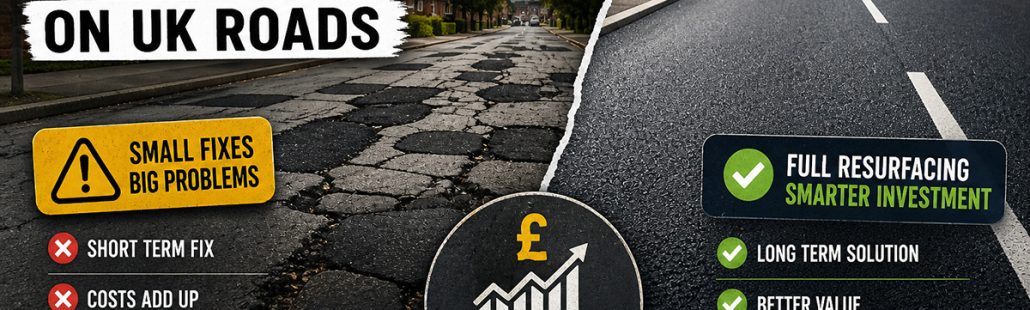
However, patchwork road repairs UK projects often mask deeper structural problems. While they restore short-term usability, they can gradually increase long-term expenditure if underlying issues are not addressed.
Understanding the hidden costs of repeated patching helps commercial sites make better infrastructure decisions.
The Difference Between Surface Defects and Structural Failure
Not all road defects are superficial. A single pothole may result from isolated impact damage, but repeated failures in the same location often indicate deeper sub-base weakness or drainage problems.
If the root cause remains untreated, patching only repairs the symptom. Water continues to penetrate, traffic continues to stress weakened layers and deterioration resumes.
Professional commercial surfacing projects assess structural integrity before determining whether resurfacing or reconstruction is required.
The Escalating Financial Impact
At first glance, patching seems affordable. However, repeated repairs in the same areas quickly accumulate. Labour costs, material costs and operational disruption add up over time.
In many cases, the combined expense of multiple patchwork repairs exceeds the cost of a properly planned resurfacing programme. What appeared to be a saving becomes a long-term financial burden.
Additionally, ongoing reactive maintenance makes budgeting unpredictable, which can complicate asset management planning.
Water Ingress and Accelerated Deterioration
Every time a road is cut and patched, new joints are created. These joints can become weak points if not perfectly sealed. Moisture infiltration through poorly bonded seams accelerates structural breakdown.
In the UK climate, frequent rainfall compounds this issue. Water that penetrates beneath patches weakens surrounding material, leading to further cracking and failure.
While timely pothole repairs are essential for safety, they should form part of a broader maintenance strategy rather than a permanent solution.
Uneven Surfaces and Safety Risks
Patchwork repairs often create slight level differences between old and new material. Over time, these irregularities may become more pronounced as surrounding areas settle.
Uneven surfaces can increase trip hazards for pedestrians and reduce vehicle stability, particularly in high-traffic commercial environments. For logistics hubs and industrial estates, surface inconsistency may also impact vehicle handling and loading operations.
Maintaining a uniform surface through proper tarmac installation or resurfacing helps ensure long-term safety and operational efficiency.
Aesthetic and Professional Image Impact
For commercial sites, road appearance contributes to overall perception. Patchwork surfaces with visible repair areas can create an impression of neglect, even if safety is maintained.
While aesthetics may not be the primary concern, first impressions matter for clients, tenants and visitors.
Disruption to Operations
Frequent small repairs mean repeated site access restrictions. Even short-term closures can affect deliveries, staff movement and customer access.
A planned resurfacing programme may involve more significant initial disruption, but it reduces the need for repeated interruptions in the future.
When Patchwork Repairs Are Appropriate
Patchwork repairs are not inherently wrong. They are appropriate when addressing isolated damage or emergency safety issues. The problem arises when patching becomes the default strategy for widespread or recurring deterioration.
If multiple patches appear across large sections of a road, it may indicate that structural fatigue has reached a tipping point.
Taking a Strategic Approach
Instead of reacting to each defect individually, site managers benefit from conducting periodic condition assessments. Identifying patterns of failure allows for informed decisions about whether resurfacing, strengthening or reconstruction is more cost-effective.
A strategic approach transforms maintenance from reactive spending into planned infrastructure management.
Long-Term Value Over Short-Term Savings
Patchwork road repairs UK solutions provide immediate relief but rarely deliver long-term value when structural issues exist. Investing in comprehensive solutions reduces cumulative costs, improves safety and enhances operational reliability.
By focusing on foundation integrity, drainage performance and correct thickness, property owners can move beyond short-term fixes and secure durable infrastructure for years to come.