
- min min
- No Comments
- June 1, 2026
Machine-Laid vs Hand-Laid Tarmac: Which Is Better for Commercial Projects?
When planning surfacing works for a commercial site, one of the most important decisions is whether to use machine-laid or hand-laid tarmac. Both methods are widely used across the UK, but they serve different purposes and deliver different results depending on the scale and complexity of the project.
Understanding the strengths and limitations of each approach helps property owners and site managers choose the most suitable option for long-term durability and value.
What Is Machine-Laid Tarmac?
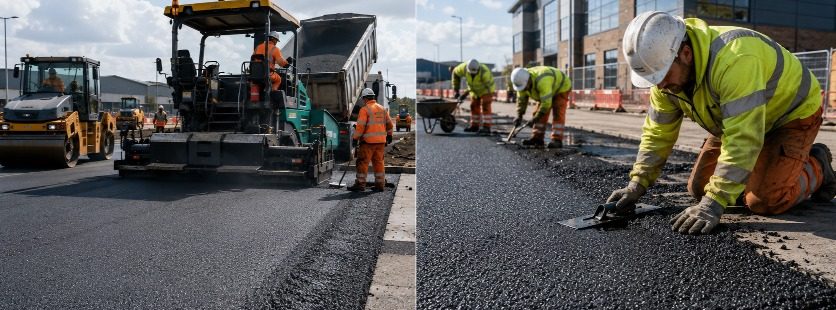
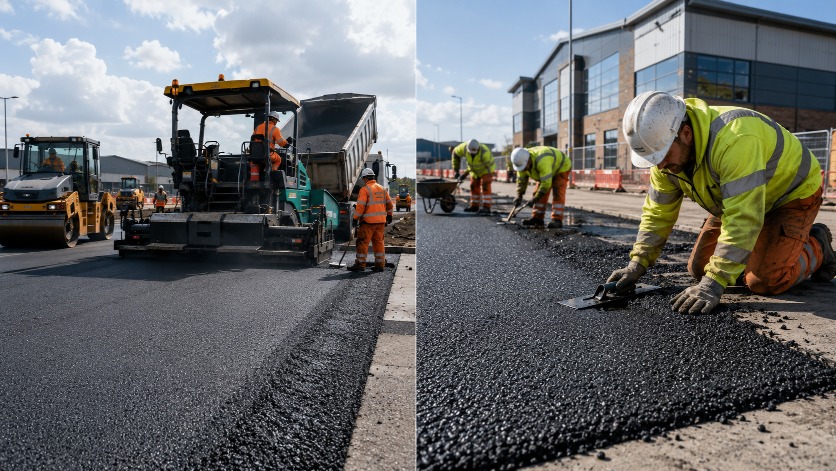
Machine-laid tarmac involves the use of a paving machine to spread and level asphalt evenly across large areas. The machine controls thickness and width with precision, ensuring consistent application across the surface.
For extensive car parks, access roads and industrial estates, machine lay tarmac is often the preferred solution due to its efficiency and uniform finish.
The mechanical process allows for continuous laying, reducing the number of joints and minimising potential weak points.
What Is Hand-Laid Tarmac?
Hand-laid tarmac is installed manually using rakes and other hand tools to distribute the asphalt before compaction. This method is typically used for smaller areas, confined spaces or intricate layouts where machinery cannot easily operate.
Hand laying offers flexibility and control in tight spaces, such as footpaths, patch repairs or around drainage features.
However, achieving perfectly consistent depth across larger surfaces can be more challenging compared to machine application.
Consistency and Finish Quality
For commercial projects requiring large uninterrupted surfaces, machine-laid tarmac provides superior consistency. The automated screed ensures even thickness and smoother levels across the entire area.
Consistency plays a major role in structural performance. Uneven depth can lead to weak spots that deteriorate prematurely under heavy traffic.
Professional commercial surfacing projects often favour machine laying for this reason, particularly where high traffic volumes are expected.
Speed and Efficiency
Machine-laid tarmac is significantly faster for large-scale works. Continuous asphalt feed and automated levelling allow crews to cover substantial areas in a shorter timeframe.
Reduced installation time means less disruption to business operations, which is especially important for retail parks, logistics hubs and busy industrial sites.
Hand-laid tarmac, while effective for smaller areas, generally requires more labour and longer installation periods when covering extensive surfaces.
Structural Strength and Durability
When properly compacted, both methods can deliver durable results. However, machine laying reduces the risk of inconsistencies that may affect long-term performance.
Fewer joints and uniform depth contribute to improved load distribution. This is particularly important in commercial environments where heavy vehicles frequently manoeuvre and apply concentrated stress.
Correct tarmac installation ensures that compaction and bonding meet structural requirements, regardless of method.
Suitability for Repairs and Small Areas
Hand-laid tarmac remains the better option for small repairs, patching and detailed areas. It allows contractors to work precisely around existing features without the need for heavy machinery.
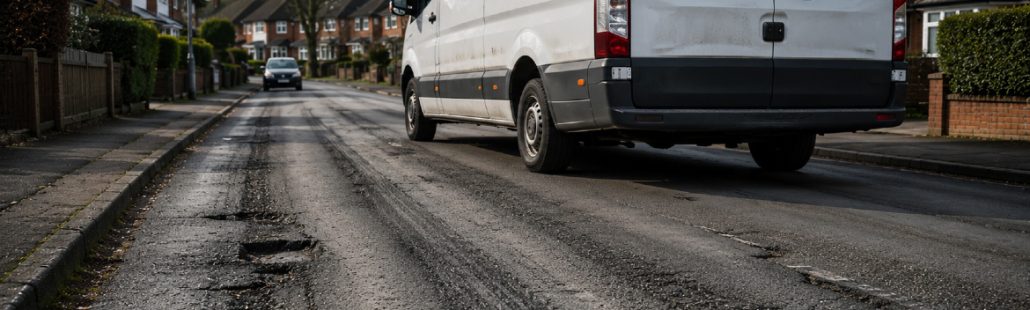
For example, localised damage requiring pothole repairs is typically completed using hand-laying techniques due to the limited area involved.
Using a paving machine for small patches would be impractical and inefficient.
Cost Considerations
Machine-laid tarmac can offer better value for large commercial projects due to efficiency and reduced labour costs per square metre. While the machinery itself represents an investment, the productivity gains often offset this expense.
Hand-laid tarmac may appear less costly for small areas but can become more expensive when applied across extensive surfaces due to additional labour time.
Project size and complexity should therefore guide cost comparisons.
Which Is Better for Commercial Projects?
For large-scale commercial roads, car parks and industrial yards, machine-laid tarmac is generally the superior option. Its consistency, speed and structural reliability make it ideal for high-traffic environments.
Hand-laid tarmac remains essential for detailed areas, small-scale works and repair projects.
Rather than viewing one method as universally better, the most effective approach often involves selecting the appropriate technique for each part of the project.
Conclusion
Machine-laid and hand-laid tarmac both have valuable roles in commercial surfacing projects. Machine laying offers consistency, speed and durability for large areas, while hand laying provides flexibility and precision for smaller sections.
For commercial sites seeking long-term performance and minimal disruption, machine laid tarmac UK solutions are typically the preferred choice. However, successful outcomes ultimately depend on professional planning, correct specification and skilled workmanship.
Choosing the right method ensures that your road or car park delivers reliable performance for years to come.