
- Minisgreat
- No Comments
- October 2, 2026
Why Utility Trenches Become the Weakest Part of a Road
Drive along almost any established UK road and you will see evidence of what lies underneath it.
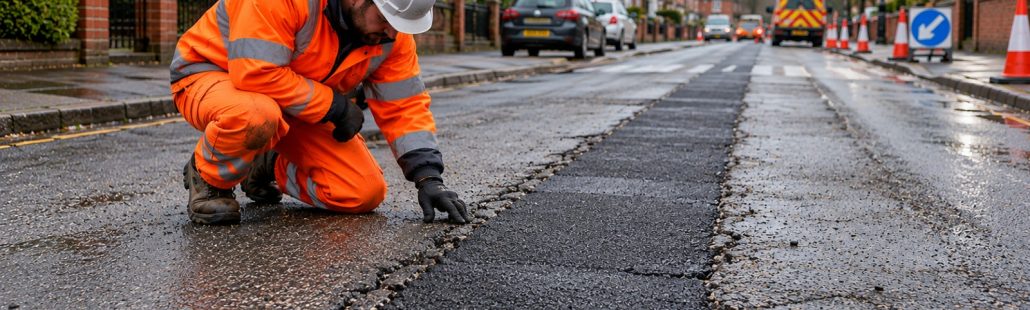
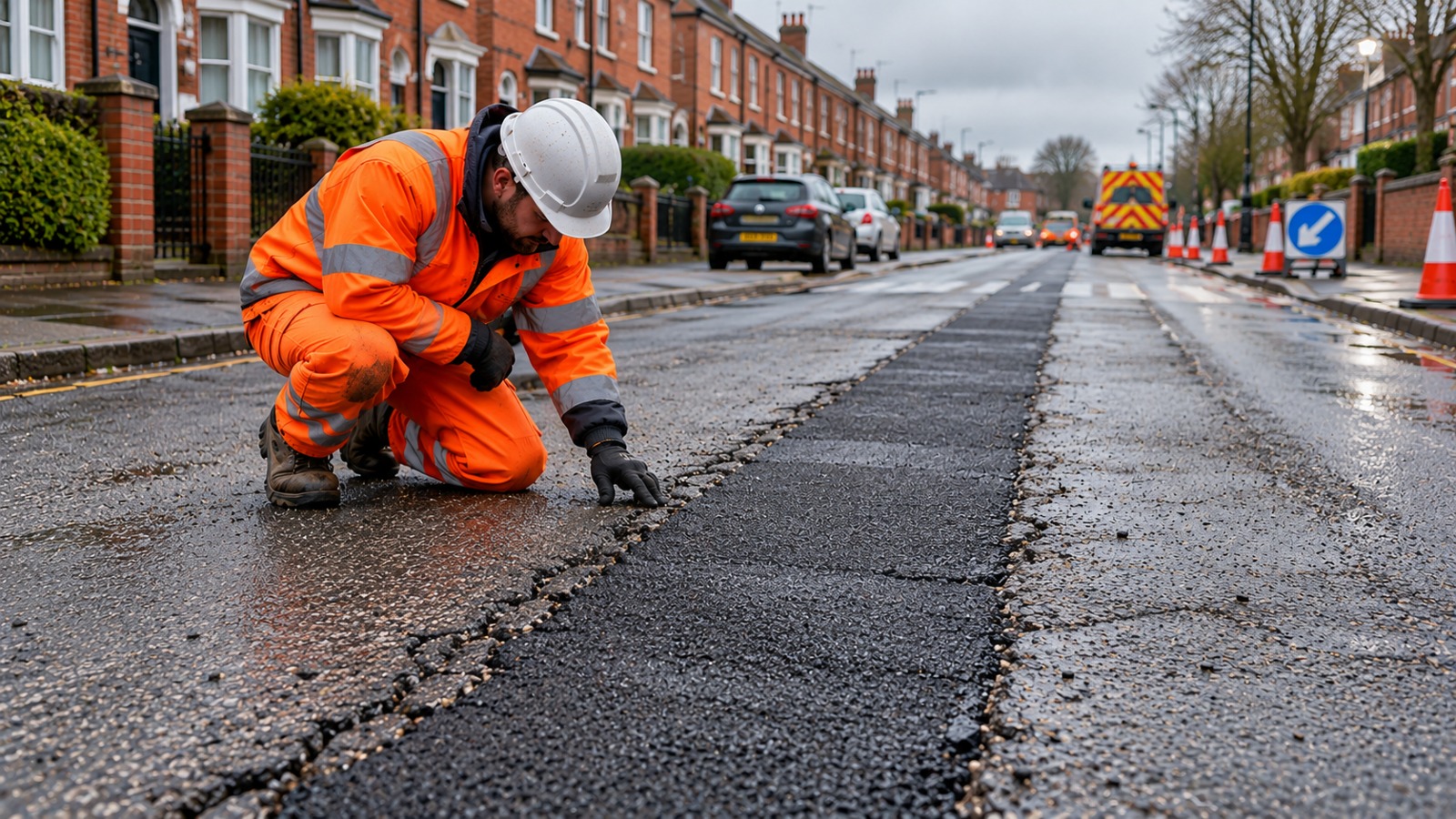
Long rectangular patches, narrow strips of newer asphalt and straight joints cutting through an older carriageway often show where the road has previously been excavated for underground services.
Water mains, gas pipes, electricity cables, drainage infrastructure and telecommunications equipment all need to reach homes and businesses. Installing, repairing or replacing those services can require contractors to cut through an existing road.
Once the work is complete, the trench is backfilled and the road surface reinstated.
The road may look perfectly acceptable immediately afterwards. Months or years later, however, cracks, depressions and potholes can begin developing around the reinstatement.
This is not simply because somebody has placed a different piece of tarmac into the road. Excavating a completed pavement changes a carefully constructed system, and restoring that system consistently can be challenging.
Understanding utility trench road damage UK property owners and site managers encounter helps explain why these narrow excavations can eventually become some of the most vulnerable parts of a road.
A Road Works as One Continuous Structure
A properly constructed road is made from several layers working together.
The visible asphalt is only the upper part of the pavement. Underneath are supporting layers designed to distribute vehicle loads into the ground.
When those layers are continuous and consistently compacted, loads can be transferred through the pavement relatively evenly.
A utility trench interrupts that structure.
Contractors have to cut through the asphalt and excavate the materials underneath until they reach the required service depth. Once the utility work is complete, the excavated section must effectively be reconstructed within the surrounding road.
That creates a narrow strip of new construction surrounded by older, established pavement.
Even when the reinstatement looks almost identical at the surface, the materials underneath may behave differently.
The Original Road Has Already Settled
An existing road may have carried traffic for many years before a utility trench is excavated.
During that period, its materials have experienced repeated loading and environmental changes.
The pavement has effectively reached an established condition.
A newly reinstated trench is different.
The backfilled material has recently been excavated, replaced and compacted. If it does not achieve adequate density and stability during reinstatement, further settlement can occur once vehicles begin passing over it.
That difference between the established road and the newer trench is one reason cracks can form along reinstatement boundaries.
The road on one side may remain relatively stable while material within the trench moves slightly.
The surface above then has to accommodate the difference.
Compaction Is Critical Inside the Trench
Backfilling a utility trench is not simply a matter of filling the hole and putting asphalt on top.
The supporting material needs to be placed and compacted appropriately.
This can be more difficult than compacting material across a large, open construction area.
A trench is narrow and constrained by its sides. Pipes, cables and other services can restrict access, while different depths may require careful placement of material.
If a section receives inadequate compaction, small voids can remain within the construction.
Traffic loading can then gradually compress the material.
The surface may initially remain intact, but eventually a shallow depression can form directly above the trench.
This is why correct preparation and compaction are fundamental to professional tarmac installation, whether the work involves an entirely new road or reinstating part of an existing one.
Why Trenches Sometimes Sink After the Work Is Finished
Settlement is one of the clearest signs that a reinstated area is behaving differently from the surrounding pavement.
The affected strip may gradually become lower than the original road.
At first, the difference can be subtle. Drivers may barely notice it.
As movement continues, however, the depression can become more pronounced. Vehicle tyres repeatedly strike the change in level, adding further loading to the edges of the reinstatement.
Water may also begin collecting in the lower area.
What started as a small amount of settlement can therefore create several additional conditions that encourage deterioration.
The Joint Between Old and New Asphalt Is a Vulnerable Area
Every trench reinstatement creates boundaries between the existing road and the newly installed material.
These joints deserve particular attention.
The original pavement and the reinstated section need to form an effective connection. If the joint begins opening, water can potentially enter the pavement.
Once moisture reaches vulnerable supporting materials, the problem is no longer limited to the visible surface.
Traffic continues loading both sides of the joint, while water and seasonal weather act on the construction underneath.
A narrow crack along the edge of a trench can therefore be the beginning of more extensive deterioration.
Why Cracks Often Trace the Exact Shape of a Trench
Utility-related road cracks frequently have a distinctive appearance.
Rather than developing randomly, they can follow straight lines along one or both sides of the reinstatement.
This pattern provides an important clue.
The crack is often forming at the interface between two sections of pavement that were constructed at different times.
If the trench settles slightly while the surrounding road remains stable, stresses concentrate along that boundary.
Eventually, the asphalt can crack.
Repairing the visible line may improve the appearance, but if movement underneath continues, the crack can reopen.
Water Can Turn a Small Joint Defect Into a Bigger Problem
Water is one of the most persistent threats to a damaged pavement.
Once a reinstatement joint begins cracking, rainfall has a potential route into the road.
The problem can become more serious during the wetter parts of the UK year.
Moisture can affect already vulnerable material beneath the surface, while traffic repeatedly loads the same area.
During colder conditions, moisture within damaged pavement can contribute to further deterioration as temperatures fluctuate.
The result can be progressive breakdown along the edges of the trench.
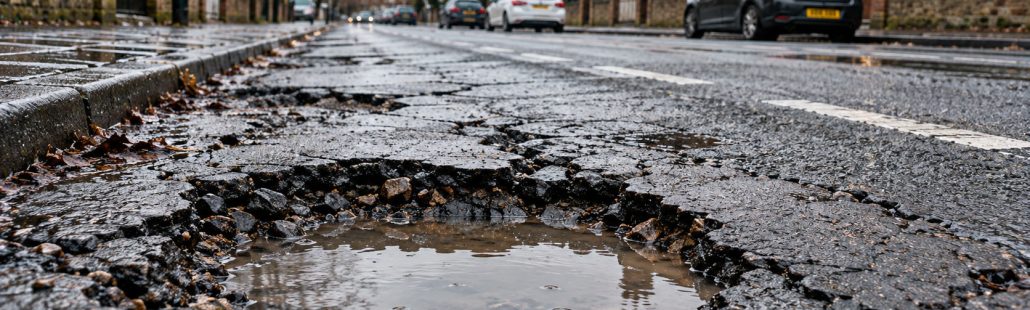
A defect that started as a narrow crack may eventually become loose asphalt and, ultimately, a pothole.
Why Potholes Often Form Beside Utility Repairs
It is common to see potholes developing along the edge of a previous road excavation rather than directly in the centre of the reinstated strip.
There is a practical reason for this.
The joint represents a transition between different areas of pavement.
If water enters there or the trench begins settling, the asphalt around that boundary experiences additional stress.
Vehicle tyres repeatedly cross the weakened area and begin breaking away loose material.
Once the edge of the surface is damaged, each passing vehicle can enlarge the defect.
Professional pothole repairs should therefore consider the surrounding pavement condition, particularly where the defect is associated with an old reinstatement.
Simply filling the visible hole may not address continuing settlement or a failing joint nearby.
Heavy Vehicles Can Expose Weak Trenches Faster
A lightly trafficked residential road and a busy industrial access route place very different demands on reinstatement work.
Heavy vehicles generate substantial loads through their tyres and axles.
If a trench crosses the carriageway, those vehicles repeatedly travel across the reinstated section.
Even a relatively small difference in support between the original road and the trench can become increasingly significant under heavy loading.
This is particularly important on industrial estates, distribution centres and other commercial sites.
Appropriate commercial surfacing needs to account for the traffic using the pavement because construction that performs adequately under cars may respond differently to frequent vans, buses or HGVs.
A Trench Across the Road Can Be Especially Noticeable
The direction of an excavation influences how vehicles interact with it.
A trench running across the full width of a road is crossed by almost every vehicle.
Both wheels may encounter the reinstatement within moments of each other, repeatedly loading the same boundaries.
If settlement develops, drivers may begin feeling a noticeable bump or dip each time they cross it.
The repeated impact can add further stress to already vulnerable edges.
By contrast, a longitudinal trench running in the same direction as traffic may place one wheel path close to or directly over a reinstatement for a much greater distance.
Neither orientation automatically causes failure, but each creates different loading patterns.
Drainage Can Change When a Trench Settles
Even small changes in road level can affect where water travels.
Roads are constructed with deliberate falls so rainfall moves towards suitable drainage points.
If a utility trench settles below the surrounding carriageway, it can create a narrow low point.
Water may then collect along the reinstatement rather than continuing towards the intended drainage route.
This creates an unfortunate cycle.
Settlement produces standing water. Standing water increases moisture exposure around cracks and joints. The pavement deteriorates further, allowing additional water into the construction.
Addressing the surface without considering the altered levels can leave that cycle in place.
Multiple Utility Works Can Create a Patchwork Road
Some roads are excavated repeatedly over their working life.
One trench may be required for a water main, another for telecommunications and another for drainage or electricity.
Localised repairs can also add further joints.
Over time, the road can become a patchwork of original pavement and different generations of reinstatement.
Every interface represents a potential difference in material, age, compaction and structural behaviour.
This does not mean every repaired section will fail, but increasing the number of joints can make pavement maintenance more complicated.
Eventually, there may come a point where treating individual defects is less practical than resurfacing a larger continuous area.
Why Laying New Asphalt Over the Top Doesn’t Always Solve It
When a road contains numerous trench repairs, resurfacing can make it look dramatically better.
A new continuous asphalt layer removes the visible patchwork and restores a uniform appearance.
However, resurfacing does not automatically eliminate movement deeper in the pavement.
If a utility trench underneath is still settling, the new surface can eventually respond to that movement.
Cracks may begin appearing above the old reinstatement boundaries.
The surface has changed, but the structural difference underneath remains.
This is why road condition needs to be assessed before deciding whether an overlay alone is appropriate.
Machine Laying Can Restore a More Consistent Surface
Where larger sections of pavement require resurfacing, machine installation can help achieve a controlled, consistent finish.
Professional machine lay tarmac is particularly suitable for larger areas where uniform placement and levels are important.
However, the same principle applies here as with any resurfacing project.
The new asphalt needs suitable support.
If failed utility trenches remain underneath, those areas may require deeper attention before the final surface is installed.
A smooth new wearing course should be the final stage of the repair, not a method of hiding structural weaknesses.
Why Some Trench Repairs Last and Others Don’t
The presence of a utility trench does not mean road failure is inevitable.
A properly designed and executed reinstatement can perform effectively.
The difference lies in the details that are largely invisible once the road reopens.
Material selection matters. Compaction matters. Joint construction matters. Drainage matters. The condition of the surrounding pavement also matters.
Traffic loading then determines how demanding the reinstatement’s working environment will be.
This explains why two visually similar trench repairs can perform very differently over time.
Their surfaces may look identical, while the quality and stability of the construction underneath are not.
What Should Site Managers Watch For?
Previous utility trenches should receive particular attention during routine inspections of private roads and commercial sites.
A slight difference in level can be an early indication of settlement.
Straight cracks following the reinstatement boundary can indicate movement or joint deterioration.
Recurring puddles may suggest that levels have changed, while loose material along the edges can indicate that the surface is beginning to break apart.
None of these signs automatically means complete reconstruction is required.
They do, however, provide useful information about how the pavement is performing.
Investigating them early can prevent a relatively narrow defect from becoming a larger damaged area.
Repairing the Cause Is More Important Than Hiding the Line
A cracked utility trench can tempt property owners to focus exclusively on making the visible line disappear.
That is understandable, but appearance should come after diagnosis.
If the crack is stable and the surrounding pavement remains structurally sound, a local repair may be appropriate.
If the trench is continuing to settle, simply sealing or covering the surface may provide only temporary improvement.
More extensive work can involve removing affected materials and rebuilding the unstable area before restoring the asphalt.
The correct repair depth should correspond to the depth of the actual failure.
Utility Trenches Reveal Why Road Construction Is About More Than Tarmac
Utility trench road damage UK sites experience provides a useful demonstration of how roads really work.
The asphalt surface is only one part of the structure.
Cut through a road to access underground services and the supporting pavement layers also have to be disturbed. Rebuilding those layers so that a narrow strip performs consistently with the established road around it requires careful material placement, compaction and surface reinstatement.
When that process works properly, the trench can become almost unnoticeable in everyday use.
When it does not, the signs often appear gradually.
A straight crack develops. The reinstatement sinks slightly. Rainwater starts collecting. The joint breaks apart and traffic enlarges the defect until a pothole forms.
That is why the weakest-looking part of a road is not always the oldest part.
Sometimes it is the section that was opened, rebuilt and asked to behave exactly like pavement that had never been disturbed.