
- Minisgreat
- No Comments
- August 23, 2026
Can Pressure Washing Actually Damage a Resin Driveway?
A resin bound driveway is often chosen because it provides a clean, attractive finish without the maintenance demands associated with some traditional paving systems. However, it still needs occasional cleaning.
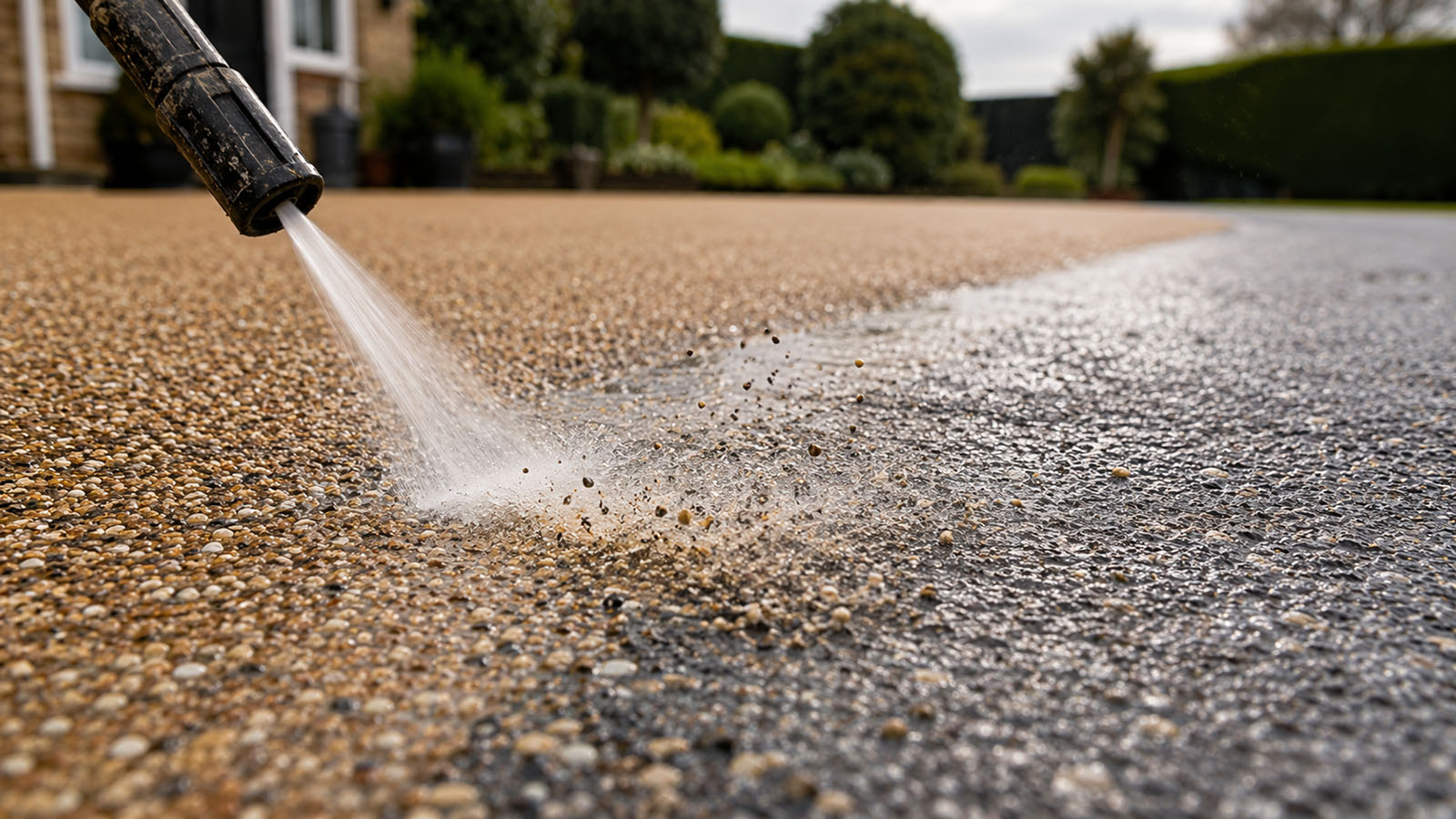
Leaves, mud, tyre marks, moss and airborne dirt can gradually accumulate, particularly on shaded driveways or surfaces close to trees. Pressure washing may seem like the obvious solution, but property owners sometimes worry that a powerful jet of water could damage the resin or blast stones from the surface.
The answer is that a properly installed resin bound driveway can generally tolerate appropriate cleaning. Problems arise when excessive pressure, aggressive nozzles or poor technique are used, particularly if the surface already contains weaknesses.
Understanding pressure washing resin driveway UK surfaces correctly can help maintain their appearance without accidentally shortening their lifespan.
Why Resin Bound Driveways Need Cleaning
Resin bound surfacing consists of decorative aggregate mixed with resin before being laid onto a suitable base. Once cured, the stones form a bonded, relatively smooth surface rather than behaving like loose gravel.
Professional resin bound surfacing is relatively straightforward to maintain, but that does not mean it should simply be ignored after installation.
Organic material can collect on the surface over time. Damp leaves, soil and other debris can encourage moss and algae, especially where sunlight and airflow are limited.
Routine cleaning helps preserve the appearance of the driveway while reducing the likelihood of slippery contamination developing.
Can a Pressure Washer Remove the Stones?
On a sound resin bound surface, aggregate should not simply fly out under normal cleaning.
The stones are held together by the cured resin, meaning they are fundamentally different from loose gravel.
However, an extremely concentrated jet applied very close to the driveway can place unnecessary stress on the surface. If aggregate is already poorly bonded because of age, installation defects or existing damage, aggressive pressure washing may expose or accelerate that weakness.
The important distinction is that pressure washing may not necessarily create the original problem. It can reveal a problem that was already developing.
If large quantities of aggregate begin coming loose during ordinary cleaning, the condition of the driveway deserves closer investigation.
High Pressure Is Not Always Better
There is a common assumption that more pressure means better cleaning.
For external surfaces, that is not necessarily true.
Extremely high pressure can remove surface contamination quickly, but it also concentrates significant force into a very small area. Holding the nozzle close to the resin intensifies that effect.
A gentler approach allows dirt to be removed progressively without repeatedly attacking the same small section of surface.
The objective should be to clean the driveway, not strip it.
Nozzle Choice Makes a Difference
The type of spray pattern used can dramatically change how force is applied to the driveway.
A narrow, concentrated jet focuses water onto a tiny area and is therefore much more aggressive. A wider fan distributes the pressure across a broader section of surface.
For general driveway cleaning, a controlled wider spray is usually more appropriate than attempting to cut through dirt with the narrowest possible jet.
Special attention should also be given to edges, joints and any existing repaired sections, where aggressive cleaning may be less appropriate.
Keep the Nozzle Away From the Surface
Distance is another important part of safe pressure washing.
The closer the nozzle is held to the driveway, the greater the force acting on the resin and aggregate. Moving it farther away spreads the jet and reduces its intensity.
Starting at a sensible distance and gradually adjusting the technique is preferable to immediately placing the lance close to the surface.
If contamination is difficult to remove, repeated gentle passes are generally a better approach than concentrating maximum pressure on one stubborn patch.
Don’t Hold the Jet in One Place
Keeping a pressure washer stationary can concentrate force on a single area for too long.
Instead, the spray should be moved consistently across the driveway. Overlapping passes help achieve a uniform finish while reducing the likelihood of individual sections receiving excessive treatment.
This also helps prevent visible cleaning lines where some parts of the driveway become noticeably cleaner than others.
A methodical approach generally produces a more consistent result.
Existing Loose Aggregate Changes the Situation
If stones are already coming loose before cleaning begins, pressure washing requires particular caution.
Loose aggregate may indicate that the resin has deteriorated, the original mixture was incorrect or the surface has suffered physical damage.
Using aggressive pressure in these areas can remove additional material and make the defect more noticeable.
Cleaning should not be treated as a repair method.
Where aggregate loss is increasing, the cause should be assessed before the driveway is subjected to intensive washing.
Poor Installation Can Become Visible During Cleaning
A correctly installed resin bound surface depends on accurate mixing, suitable materials, appropriate weather conditions and good preparation underneath.
If insufficient resin was used or the aggregate was not coated consistently, certain areas may be weaker than others.
Those weaknesses might remain relatively difficult to see during everyday use.
Pressure washing can sometimes expose them because poorly bonded aggregate begins breaking away while stronger surrounding areas remain unaffected.
In this situation, blaming the pressure washer alone overlooks the underlying installation issue.
Age Can Affect How a Surface Responds
Like any external pavement, resin bound surfacing is exposed continuously to weather, vehicles and temperature changes.
An older driveway may therefore require a more cautious cleaning approach than a relatively new surface in excellent condition.
Before pressure washing, it is sensible to inspect for cracks, loose aggregate, edge damage and areas where the texture appears noticeably different.
These locations can then be treated more gently or avoided until their condition has been assessed.
Moss and Algae Need More Than Brute Force
Moss and algae can make a driveway look neglected and potentially reduce surface grip during wet weather.
A pressure washer can help remove contamination, but relying entirely on maximum water pressure is not always the best strategy.
Removing loose debris regularly prevents much of the organic material needed for growth from accumulating in the first place. Appropriate cleaning methods can then deal with more established contamination without unnecessarily attacking the resin surface.
Prevention usually requires less intensive cleaning than waiting until the driveway becomes heavily covered.
Drainage Should Be Considered During Cleaning
One of the advantages of a correctly designed resin bound system is its potential permeability.
Dirt, fine sediment and organic material can accumulate at the surface over time, so keeping it clean helps preserve effective water movement.
However, drainage around the driveway still matters.
Cleaning large amounts of debris towards channels or gullies can create blockages elsewhere on the property. Waste material should therefore be removed rather than simply pushed into drainage infrastructure.
After cleaning, it is worth checking that nearby channels and outlets remain clear.
Be Careful Around the Edges
The perimeter of a resin driveway deserves additional care.
Edges may meet walls, kerbs, drainage channels, paving or other surfacing materials. Directing a concentrated jet into these interfaces can place unnecessary pressure on vulnerable joints.
Where a driveway edge is already cracked or damaged, water can potentially enter the affected area.
Using lower pressure and avoiding prolonged direct spraying into joints helps protect these transitions.
What If Cracks Appear After Pressure Washing?
If a crack becomes noticeable after cleaning, it is important to determine whether the pressure washer genuinely caused it or simply made an existing defect easier to see.
Cracks in resin surfaces can originate from movement underneath. An unstable base, deterioration in an existing substrate or local settlement can transfer stress into the resin above.
This is similar to what happens with tarmac installation: the visible wearing surface relies on the construction beneath it for long-term stability.
Where structural movement is responsible, cleaning technique alone will not solve the problem.
Can Commercial Resin Areas Be Pressure Washed?
The same general principles apply to commercial areas, although their maintenance requirements may be greater because of heavier use.
Entrances, pathways and customer-facing areas can accumulate substantially more dirt than a domestic driveway. Regular cleaning may therefore form part of a planned maintenance programme.
Professional commercial surfacing should always consider how a finished area will be used and maintained, rather than focusing solely on its appearance on installation day.
A surface that can be maintained effectively throughout its lifespan provides much better long-term value.
How Often Should a Resin Driveway Be Cleaned?
There is no single schedule suitable for every property.
A sunny driveway away from trees may remain relatively clean with little intervention, while a shaded surface surrounded by vegetation may require more frequent attention.
The better approach is to monitor the condition of the driveway.
Regular sweeping prevents leaves, soil and debris from building up. More thorough washing can then be carried out when the surface genuinely needs it rather than according to an arbitrary timetable.
This reduces unnecessary aggressive cleaning while keeping the driveway presentable.
When Should You Stop Pressure Washing?
Cleaning should be stopped if significant aggregate begins coming loose, the surface starts breaking apart or an existing damaged section noticeably worsens.
Those signs suggest that continuing with more pressure could cause unnecessary deterioration.
The surface should instead be inspected to determine why the material has become vulnerable.
A small localised defect may require a relatively straightforward repair, whereas widespread stone loss could indicate a larger problem with the installation or underlying structure.
Maintenance Should Protect the Surface, Not Test Its Limits
Pressure washing should never become a test of how much force a driveway can withstand.
The objective is simply to remove contamination efficiently while preserving the resin and aggregate underneath.
A controlled fan spray, sensible working distance, continuous movement and particular care around damaged areas provide a much safer approach than using the most aggressive setting available.
Regular light maintenance also reduces the need for intensive cleaning in the first place.
So, Can Pressure Washing Damage a Resin Driveway?
Yes, it can if it is carried out excessively aggressively, particularly on a surface that is already damaged or poorly bonded. That does not mean pressure washers should automatically be avoided.
A sound, professionally installed resin bound driveway should be capable of routine appropriate cleaning. Problems are more likely when very concentrated jets are held close to the surface, repeatedly directed at vulnerable edges or used aggressively against existing defects.
For property owners concerned about pressure washing resin driveway UK surfaces, the key is moderation.
Inspect the driveway first, remove loose debris, use controlled pressure and avoid attacking individual areas unnecessarily. If ordinary cleaning begins releasing significant quantities of aggregate, investigate the condition of the surface rather than simply turning the pressure down and ignoring it.
A resin driveway should be maintained carefully, not aggressively. Done correctly, cleaning can preserve its appearance, drainage performance and usability for years without damaging the surface.