
- Minisgreat
- No Comments
- September 7, 2026
Ever Wondered What’s Actually Under a UK Road?
Most people look at a road and see tarmac.
There is a kerb at either side, perhaps a drainage gully nearby, road markings on top and a dark surface carrying thousands of vehicles. It is easy to assume that the visible asphalt represents most of the road construction.
In reality, the surface is only the final part of a much deeper system.
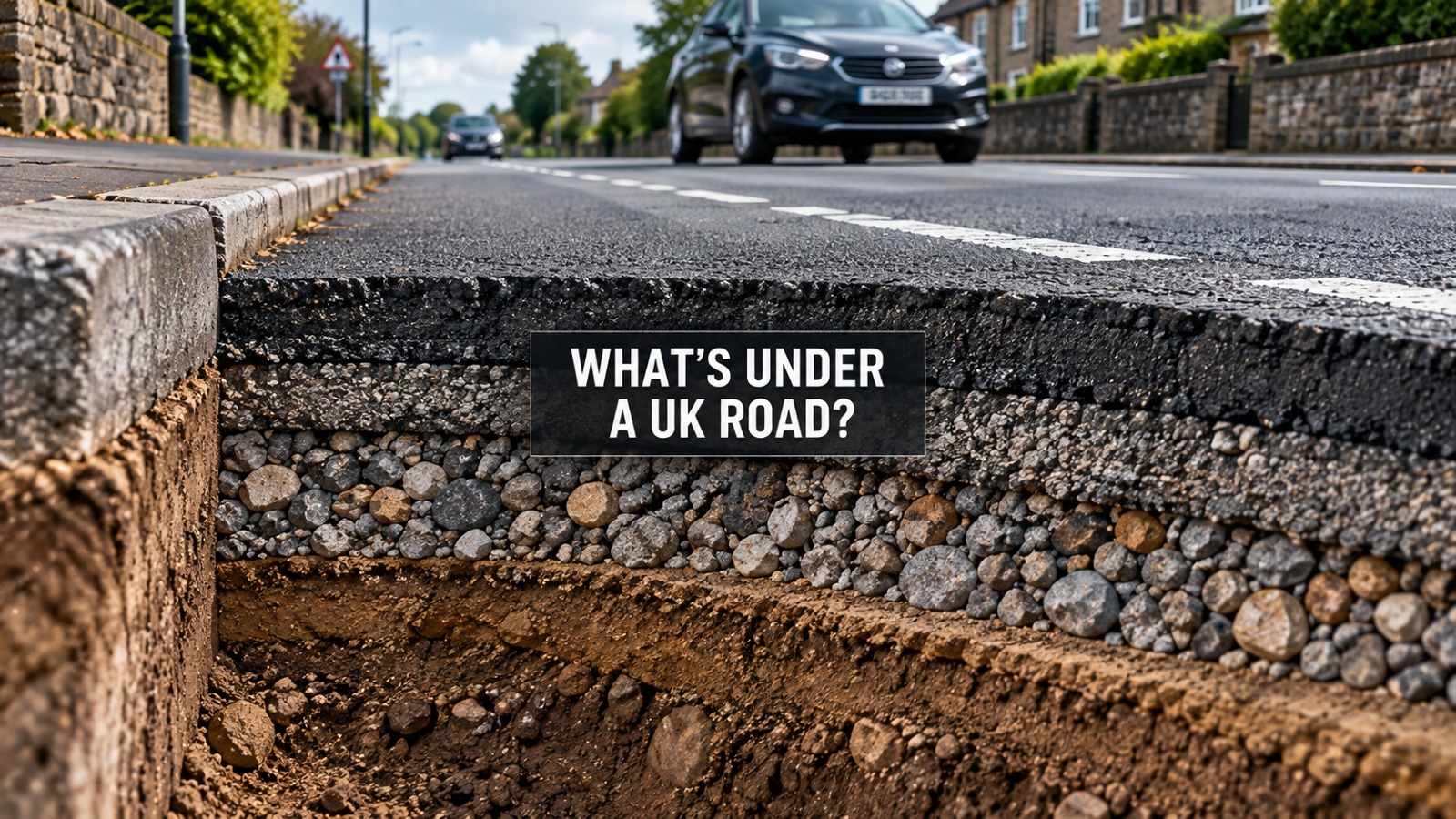
Underneath a properly constructed road are several layers, each performing a different job. Some provide structural strength, some distribute vehicle loads and others create the smooth, durable surface that tyres actually contact.
The exact construction varies depending on the location, ground conditions, traffic loading and engineering specification. A quiet private access road does not necessarily require the same pavement design as an industrial route regularly carrying heavily loaded HGVs.
Understanding UK road construction layers helps explain something important about road maintenance: when a surface fails, the cause is not always located in the part of the road you can see.
It All Starts With the Ground Underneath
At the bottom of the road construction is the natural ground, generally referred to as the subgrade.
Everything above ultimately relies on this ground being capable of supporting the pavement.
The condition of the subgrade can vary considerably between sites. Soil type, moisture content, previous excavation and local ground conditions can all influence how it performs.
If the ground is weak or unstable, simply placing asphalt over it will not create a durable road.
Preparation may therefore involve excavation, grading, compaction or other measures appropriate to the site before the pavement layers are constructed.
This is one reason professional road construction starts long before any tarmac arrives.
Why Weak Ground Can Cause Problems at the Surface
Imagine placing a strong board on a soft, unstable surface and repeatedly applying weight to it.
Even if the board itself is durable, movement underneath can eventually affect its position.
Roads work on a similar principle.
The upper pavement layers distribute vehicle loads, but they still depend on adequate support beneath them. If the underlying ground moves excessively, the layers above can begin flexing or settling.
Eventually, that movement may become visible as cracking, depressions or uneven areas in the road surface.
The visible defect can therefore be several layers removed from the actual cause.
The Sub-Base Creates a Strong Foundation
Above the prepared ground is typically a sub-base.
This is one of the most important structural parts of the pavement.
The sub-base is generally constructed using suitable granular material that is placed and compacted to create a stable foundation for the layers above.
Its job includes distributing loads and providing a firm platform for subsequent construction.
Thickness and material specification depend on the requirements of the project. A road expected to accommodate substantial commercial traffic may require a different construction from a lightly used residential access.
Correct compaction is particularly important.
Material that has been placed but inadequately compacted can continue settling once traffic begins using the road. That settlement can eventually appear at the surface.
Why You Can’t Judge a Road by Its Surface Alone
A newly finished road can look excellent even when there are weaknesses underneath.
Fresh asphalt hides the construction below completely.
For the first few months, everything may appear smooth and uniform. If the sub-base contains poorly compacted areas, however, repeated traffic can gradually expose those weaknesses.
Depressions may form. Cracks can develop. Wheel paths may begin sinking.
This explains why quality tarmac installation depends so heavily on preparation. The appearance of the final surface matters, but its long-term performance is determined by the entire pavement construction.
The Next Layers Build Structural Strength
Above the foundation layers are the asphalt courses that create the main pavement structure.
The exact terminology and specification can vary depending on the road design, but asphalt roads commonly contain more than one asphalt layer.
This surprises some property owners.
When resurfacing work is underway, it may appear that contractors simply lay one thick layer of black material. In reality, different courses can perform different functions.
The lower asphalt layers contribute structural capacity, while the upper layers provide the characteristics needed at the road surface.
What Is the Binder Course?
The binder course sits below the final surface course in many asphalt pavement constructions.
It provides an important structural layer between the foundation and the road surface.
Because drivers never normally see it once the project is finished, it receives considerably less attention than the wearing surface. Nevertheless, it contributes significantly to the overall strength and stability of the pavement.
The material and thickness need to suit the intended loading.
If a road is expected to carry frequent commercial vehicles, simply concentrating on the top layer while under-specifying the construction beneath it can result in premature deterioration.
What Is the Surface Course?
The surface course is the part everyone sees.
It forms the uppermost asphalt layer and is designed to provide an appropriate finished surface for traffic.
This layer needs to withstand tyre contact, weather and repeated loading while providing the required surface characteristics.
When people talk about a road looking newly tarmacked, they are generally describing this upper course.
Professional machine lay tarmac can provide controlled placement across larger areas, helping create consistent levels and a uniform finished surface.
However, even an excellent surface course cannot compensate indefinitely for major structural weaknesses underneath.
How Do All These Layers Work Together?
The easiest way to understand road construction is to think of the pavement as a complete system.
When a vehicle tyre contacts the surface, it applies a concentrated load.
The pavement layers help distribute that load across a progressively wider area as it travels down through the construction.
Rather than the natural ground having to withstand the entire force directly beneath the tyre, the pavement spreads the loading.
This is why thickness, material selection and compaction matter.
Every layer contributes to how effectively the road handles traffic.
Heavy Vehicles Change the Requirements
A road used predominantly by cars experiences very different loading from one regularly carrying HGVs.
Heavy vehicles place substantially greater demands on the pavement, particularly when they brake, turn or remain stationary.
Industrial estates, distribution centres, loading areas and commercial entrances therefore need surfacing designed around their actual traffic.
Professional commercial surfacing should take vehicle type and movement into account when determining the appropriate pavement construction.
A road cannot be specified purely according to its dimensions.
How it will be used is equally important.
Why Compaction Matters at Several Stages
Road construction is not simply about putting the correct materials in the correct order.
Those materials also need to be properly compacted.
Compaction reduces voids and helps create stable layers capable of supporting traffic.
If one area receives inadequate compaction, it may continue compressing after the road opens.
That can lead to localised settlement.
The problem may initially appear as a small depression or puddle. Over time, continued loading can make the difference in level more pronounced.
Good construction therefore depends on consistency across the whole pavement, not merely achieving the correct appearance at completion.
Where Does Drainage Fit Into Road Construction?
Drainage is not simply an additional feature installed beside the road.
It is fundamental to pavement performance.
Road levels are designed so surface water travels towards appropriate drainage points rather than remaining on the carriageway.
Kerbs, channels, gullies and other drainage infrastructure may all contribute to managing rainfall.
Water also needs to be prevented from causing problems within the pavement construction itself.
If drainage fails and water repeatedly reaches vulnerable supporting layers, structural performance can deteriorate.
This is why recurring standing water deserves attention rather than being viewed purely as an inconvenience.
What Happens When Water Gets Into a Damaged Road?
Small cracks can create routes for water to enter the pavement.
Once water reaches vulnerable areas, it can contribute to further deterioration, particularly where the underlying construction is already weak.
Traffic then continues loading the affected area.
Cracks may widen, material can begin breaking away and the defect can eventually become a pothole.
Professional pothole repairs should therefore consider what is happening around and beneath the visible hole rather than simply treating it as missing surface material.
A pothole can sometimes be the final visible stage of a problem that began deeper within the pavement.
Why Utility Trenches Can Cause Road Settlement
Roads frequently need to accommodate underground infrastructure.
Water pipes, drainage, gas, electricity and telecommunications services may all require excavation through an existing pavement.
After the work is completed, the trench needs to be reinstated correctly.
If backfilled material is not compacted adequately, gradual settlement can occur.
A straight depression or recurring crack may eventually appear along the line of the previous excavation.
The asphalt surface itself may not have been the original cause. It is simply following movement in the reinstated construction underneath.
Why Do Roads Develop Tyre Ruts?
Tyre ruts are depressions that follow regular wheel paths.
They can develop when pavement materials deform under repeated loading or when supporting layers beneath the asphalt begin moving.
The distinction matters.
If deformation is confined to the upper asphalt, repairing or replacing those layers may address the problem.
If the rutting originates deeper within the foundation, resurfacing alone may only restore the appearance temporarily.
The new surface can eventually follow the same deformation underneath.
This is why investigating the depth of pavement failure is important before deciding how a road should be repaired.
Why Does Resurfacing Sometimes Fail Quickly?
A new surface is only as dependable as the pavement supporting it.
If an old road remains structurally sound but has a worn upper layer, resurfacing can be an effective way to renew it.
Problems arise when fresh asphalt is used to cover serious structural defects.
Existing cracks may reflect through the new material. Weak areas can continue settling. Drainage problems can return and old wheel-path deformation may reappear.
The surface looks new, but the deeper road is still old.
A proper assessment helps determine whether an overlay is suitable or whether sections need deeper reconstruction first.
Not Every Road Has Exactly the Same Layers
There is no single construction depth that applies to every UK road.
Pavement design depends on numerous site-specific factors.
Ground conditions matter. Expected traffic matters. Vehicle weight matters. Drainage matters. The intended lifespan and purpose of the area also influence the specification.
A domestic access road, commercial yard and heavily trafficked industrial route can therefore look similar at the surface while having very different construction underneath.
That is why simply copying the build-up used on another site is not necessarily appropriate.
What Happens During Full Road Reconstruction?
When deterioration extends deep into the pavement, replacing only the upper surface may no longer be sufficient.
Full or partial reconstruction allows failed material to be removed so the supporting layers can be restored.
Once the defective construction has been excavated, the condition underneath can be properly assessed. Suitable materials can then be installed and compacted before the asphalt layers are replaced.
This is more involved than resurfacing, but it addresses structural problems that a thin overlay cannot correct.
For heavily used roads, dealing with the foundation can provide far better long-term value than repeatedly replacing the surface.
The Black Surface Is Only the Final Chapter
When you next drive along a road, the few centimetres of material visible at the top are only part of the engineering beneath your tyres.
A typical pavement relies on prepared ground, foundation materials and asphalt courses working together. Drainage helps protect that construction, while appropriate compaction allows the different layers to perform as intended.
Understanding UK road construction layers also explains why two roads that look almost identical can perform very differently.
One may have been constructed on a strong, well-prepared foundation designed for its traffic. Another may contain weak ground, inadequate compaction or a pavement structure unsuitable for the loads it receives.
The most important parts of a road are therefore often the ones nobody sees after construction is finished.
When those hidden layers are right, the surface has the support it needs to perform. When they are wrong, even perfectly laid new tarmac can eventually reveal what is happening underneath.