
- Minisgreat
- No Comments
- August 25, 2026
The Real Causes of Tyre Ruts in Block-Paved Driveways
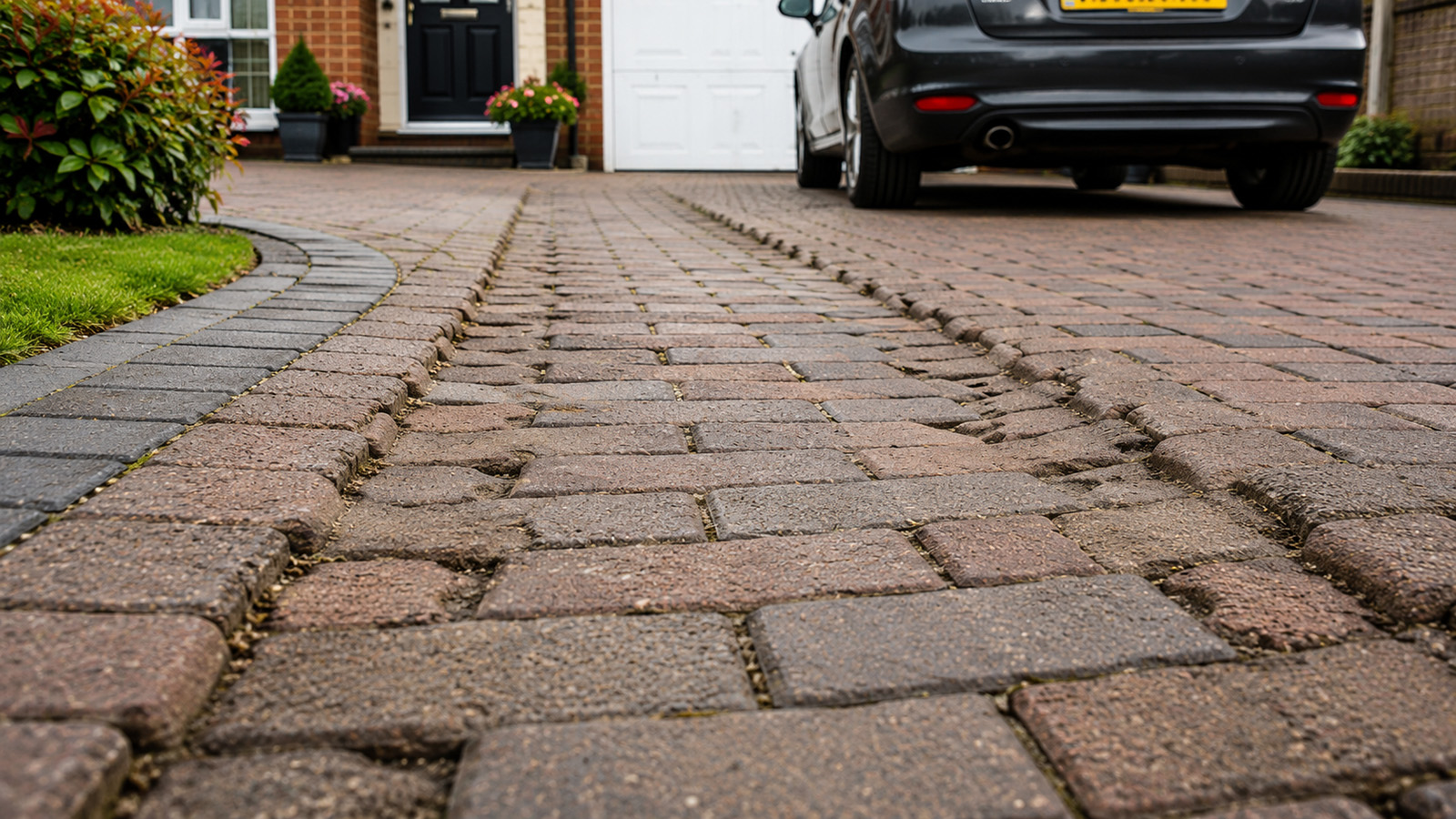
Block paving can remain attractive and functional for many years, yet one problem is particularly frustrating for property owners: two obvious depressions developing exactly where vehicle tyres travel.
At first, the change may be difficult to notice. After rainfall, two narrow puddles might begin appearing beneath the usual wheel positions. Eventually, the blocks visibly sink and the driveway develops defined tyre tracks.
It is easy to assume the weight of the car has simply pushed the blocks down. In reality, the paving blocks themselves are rarely the main problem.
Tyre ruts in block paving UK driveways usually indicate movement somewhere within the pavement construction underneath. Poor compaction, inadequate foundations, water, repeated vehicle loading and weak reinstatement can all contribute.
Understanding which factor is responsible matters because simply lifting and levelling the blocks may only hide the problem temporarily.
The Blocks Are Usually Following Movement Below
A block-paved driveway is not simply a collection of paving blocks placed on the ground.
The visible blocks form the upper surface of a layered construction. Beneath them is a laying course supported by a compacted sub-base, with the underlying ground providing further support.
When properly designed and installed, these layers distribute vehicle loads across a wider area.
If one of the supporting layers begins to move or compress, the paving above follows it.
This explains why tyre ruts often develop gradually. Each vehicle movement contributes a tiny amount of additional settlement until the difference in level becomes visible.
The same principle applies to professional tarmac installation, where the quality of the finished surface depends heavily on the strength and stability of the construction beneath it.
Poor Sub-Base Compaction Is a Major Cause
One of the first areas to investigate is the sub-base.
During construction, sub-base material needs to be placed and compacted correctly. If the process is inadequate, voids or weaker areas can remain within the pavement.
The driveway may initially look completely level because the paving has been installed to the correct finished height.
Once vehicles begin using it, however, repeated loading continues compacting the weak material underneath.
The areas receiving the greatest pressure are usually the wheel paths. Over time, these sections settle while the less heavily loaded paving between them remains closer to its original level.
The result is the familiar pair of tyre ruts.
An Inadequate Sub-Base Can Have the Same Effect
Compaction is not the only foundation issue.
The pavement construction also needs to be suitable for the loads it will experience. A driveway designed around normal domestic use may perform differently if it regularly accommodates heavier vehicles.
If the supporting structure is inadequate, repeated loading can eventually cause deformation.
This is why a surfacing project should be designed around how the area will actually be used rather than simply how it should look when completed.
The decorative blocks are only the final finish. The layers beneath them provide the structural support.
Cars Keep Using Exactly the Same Wheel Paths
Residential driveways create a particularly repetitive loading pattern.
Most drivers enter and leave their property in almost exactly the same way every day. If the driveway leads directly to a garage or fixed parking position, the tyres may travel across the same narrow strips thousands of times.
Even a relatively small weakness underneath those tracks can therefore become progressively worse.
The centre of the driveway may remain perfectly level because it receives far less direct loading.
This repeated pattern explains why rutting can be extremely localised even when the rest of the paving appears to be in excellent condition.
Parked Vehicles Create Long-Term Static Loads
The problem can be even more noticeable where a vehicle is parked in the same position every night.
Instead of loads simply travelling across the driveway, the weight remains concentrated through four tyre contact areas for hours at a time.
A correctly constructed driveway should accommodate normal domestic parking, but persistent settlement beneath a parked vehicle can reveal weaknesses in the pavement construction.
If depressions correspond exactly with regular parking positions, the supporting layers should be considered when investigating the cause.
Heavy Vehicles Can Reveal Weaknesses Quickly
A driveway that performs perfectly under ordinary cars may suddenly experience much greater loading when heavier vehicles arrive.
Removal lorries, delivery vehicles, builders’ vans and vehicles carrying construction materials can all place additional demands on the pavement.
Skips can also create highly concentrated loads, particularly when placed directly onto paving without appropriate consideration of weight distribution.
The occasional heavy vehicle does not mean a properly constructed driveway will automatically fail. However, where weaknesses already exist, greater loads can make them apparent much sooner.
For areas regularly carrying substantial vehicles, the stronger pavement designs associated with commercial surfacing may be more appropriate than a construction intended primarily for light domestic traffic.
Turning the Steering Wheel Can Make Things Worse
Vehicle weight is only part of the story.
Tyres also apply horizontal forces to paving when a vehicle turns. These forces become particularly concentrated when the steering wheel is turned while the vehicle is stationary.
The tyres effectively scrub against the blocks rather than simply rolling across them.
Repeated manoeuvring can disturb jointing material and contribute to movement where the underlying construction is already vulnerable.
Driveways with tight entrances or limited parking space can experience more of these turning forces because drivers repeatedly manoeuvre in the same locations.
Braking and Acceleration Add Further Stress
Every time a vehicle brakes, accelerates or changes direction, the driveway experiences forces beyond simple downward loading.
On sloping driveways, these stresses can be more pronounced because vehicles may brake repeatedly while entering or leaving the property.
If blocks are not adequately restrained, gradual movement can occur.
The result may not always be a straightforward depression. Paving can begin spreading, joints can widen and individual blocks may move out of alignment.
This is why tyre ruts sometimes appear alongside other signs of pavement movement.
Water Can Weaken the Structure Underneath
Water is one of the most important factors in premature pavement deterioration.
Rainwater that repeatedly enters vulnerable areas can affect the supporting construction beneath block paving. Drainage problems may also allow water to flow through parts of the pavement in ways that were not intended.
If supporting material migrates or the underlying ground becomes less stable, the surface loses some of its structural support.
Vehicle tyres then compress the weakened areas, gradually producing depressions.
The combination of water and repeated loading is particularly damaging because each problem reinforces the other.
Tyre Ruts Can Start Holding Water
Once shallow ruts have formed, they often create a secondary problem.
The original driveway may have been installed with carefully controlled falls so rainfall could travel towards a drainage channel or other suitable outlet. Once the wheel paths sink, those levels change.
Water begins collecting inside the depressions instead.
This makes tyre rutting especially noticeable after rainfall, but it can also contribute to further deterioration if water reaches vulnerable joints or supporting layers.
The rut holds water, the water contributes to weakening, and subsequent vehicle loading deepens the rut.
Without intervention, this cycle can continue.
Drainage Problems May Be the Root Cause
When investigating rutting, it is worth looking beyond the affected blocks.
A damaged drainage channel, blocked outlet or poorly controlled flow from neighbouring surfaces may be directing excessive water towards the driveway.
Downpipes and surrounding landscaping can also influence where water travels during heavy rain.
If the rutting is concentrated close to a drainage feature or area of persistent standing water, correcting the water-management problem may be essential before reinstating the paving.
Otherwise, the newly levelled area could begin sinking again.
Weak Edges Can Allow the Paving to Spread
Block paving depends on effective edge restraint.
The blocks work together as a pavement, and secure boundaries help prevent them moving sideways under vehicle loading.
If an edge restraint fails, blocks can gradually spread. Joint widths may increase and the pavement can lose some of its interlocking stability.
Vehicle movements then accelerate the process.
Areas close to driveway entrances can be particularly vulnerable because they experience repeated tyre loading, braking and turning while also sitting close to the pavement edge.
Repairing only the sunken wheel path without restoring a failed edge may therefore provide an incomplete solution.
Utility Trenches Can Create Unexpected Ruts
Not every tyre rut is caused by the original driveway construction.
Previous utility work may have disturbed the ground underneath.
Water, gas, electricity or telecommunications installations can involve excavating trenches through or beneath a driveway. If the excavated area is not reinstated and compacted correctly, the backfilled material can continue settling over time.
Where a vehicle wheel path happens to cross that weaker area, repeated loading can accelerate the settlement.
The visible depression may therefore appear to be caused by traffic when the underlying weakness actually originated from earlier excavation.
Why Adding More Sand May Only Be Temporary
Because block paving can be lifted relatively easily, a common repair is to remove the affected blocks, add laying material and reinstall them at the correct level.
That can be appropriate when the settlement is genuinely confined to the laying course.
It becomes less effective when the sub-base or ground underneath has moved.
Adding more material simply fills the space created by the settlement. It does not strengthen the weak foundation below.
The repaired driveway may look perfect initially, only for the same tyre rut to reappear after months of vehicle use.
A lasting repair requires the depth and cause of the movement to be understood.
How Proper Repairs Should Approach the Problem
Where rutting is substantial or recurring, the affected blocks need to be treated as the starting point of the investigation rather than the entire problem.
Once paving is lifted, the underlying layers can be inspected for signs of movement, inadequate material, water damage or poor compaction.
Weak sections may need to be removed and reconstructed before the blocks are reinstated.
Drainage and edge restraints should also be checked while the area is accessible.
Although this approach involves more work than simply levelling the blocks, it addresses the reason the surface moved in the first place.
Are Tyre Ruts Dangerous?
Shallow wheel tracks may initially appear to be mainly cosmetic, but they can eventually affect safety and usability.
Uneven paving can create trip hazards where vehicle areas overlap with pedestrian routes. Standing water within depressions may become slippery and can freeze during colder conditions.
Deep rutting can also make parking and manoeuvring less comfortable.
Perhaps more importantly, worsening ruts indicate that movement is continuing. Delaying investigation can allow a relatively small repair area to become substantially larger.
Can Tyre Ruts Be Prevented?
Good prevention begins during construction.
The ground needs appropriate preparation, the sub-base must be suitable for the intended traffic and each layer should be compacted correctly. Drainage must manage rainfall effectively, while strong edge restraints help keep the paving locked together.
The driveway should also be designed around realistic use.
If heavier vehicles will regularly access the property, that needs to be considered before construction rather than after settlement begins.
Routine observation can help once the driveway is in service. New puddles, widening joints or slight changes in block levels can reveal movement before deep ruts develop.
When an Alternative Surface May Be Worth Considering
Block paving remains an attractive and practical option for many residential properties, particularly where appearance and design flexibility are important.
However, some vehicle areas experience demands better suited to other pavement types.
Where a large access area receives frequent traffic or heavier vehicles, a professionally designed asphalt surface may provide a more practical solution. On other properties, resin bound surfacing may be considered where appearance and suitable drainage characteristics are priorities.
The correct choice depends on traffic, groundwork, drainage and maintenance expectations rather than appearance alone.
The Tyres Aren’t Usually the Real Problem
It is tempting to blame tyre ruts entirely on the vehicles using the driveway. After all, the depressions appear directly beneath the wheels.
But ordinary vehicle use is often exposing a weakness rather than creating one from nothing.
Inadequate sub-base construction, poor compaction, water movement, failed edges, utility trenches and loads beyond the original design can all allow the pavement to settle. The tyres simply concentrate pressure where those weaknesses exist.
For property owners dealing with tyre ruts in block paving UK driveways, the most important question is therefore not how to level the blocks. It is why the blocks moved.
Find and correct that underlying cause, and the repair has a much better chance of lasting. Ignore it, and those familiar wheel-shaped depressions may return sooner than expected.