
- Minisgreat
- No Comments
- August 17, 2026
Why Airport Tarmac Isn’t Actually Tarmac
You’ve probably heard the phrase hundreds of times. A plane is “waiting on the tarmac”, passengers are “stuck on the tarmac”, or airport staff are working “out on the tarmac”.
It has become such a familiar expression that most people naturally assume the enormous paved areas surrounding an airport are literally made from tarmac.
The reality is more interesting.
“Tarmac” has become an everyday word for a dark paved surface, but modern airport pavements are engineered structures that may use specialised asphalt or concrete depending on their location and expected loading. Runways, taxiways and aircraft parking aprons can have very different construction requirements.
Understanding the difference also reveals an important lesson about ordinary roads and commercial surfacing: what you see on top is only one part of what makes a pavement perform.
Where Does the Word Tarmac Come From?
The term tarmac comes from “tarmacadam”, a road-building method associated with the development of tar-bound macadam.
Traditional macadam construction used layers of carefully sized stone to create durable roads. Later developments incorporated tar as a binder, helping create a more stable and weather-resistant surface.
Over time, “tarmac” became a convenient general term for black road surfacing.
Today, however, modern road construction generally uses bitumen-bound asphalt rather than traditional tar-bound tarmacadam. Despite this technical distinction, the word tarmac remains deeply embedded in everyday British language.
That is why people frequently refer to almost any smooth black road, driveway or airport pavement as tarmac regardless of its exact specification.
So What Are Airport Runways Actually Made From?
There is no single material used for every airport runway.
Depending on engineering requirements, climate, aircraft loading and maintenance strategy, airport pavement can be constructed using asphalt, concrete or combinations of pavement materials.
The visible surface is also only the upper part of a much deeper engineered structure.
Beneath it are supporting pavement layers designed to distribute enormous aircraft loads safely into the ground.
The same fundamental principle applies to professional tarmac installation on roads and access areas. The quality of the finished surface depends heavily on what has been constructed underneath it.
Why Aircraft Put Extraordinary Pressure on Pavements
A commercial aircraft is vastly heavier than the vehicles using an ordinary road.
When an aircraft lands, its undercarriage must transfer substantial loads into a relatively limited area of pavement. Runways therefore need to resist repeated loading while maintaining a safe, predictable surface.
But weight is only one consideration.
Airport pavements must also cope with braking, acceleration, turning movements, temperature changes, water and repeated operational use.
That combination explains why their construction is so carefully engineered.
Runways Need More Than a Smooth Finish
Looking across a runway from a distance, it may appear almost perfectly smooth.
At tyre level, however, surface characteristics are critical.
Aircraft need dependable friction during landing and braking, particularly in wet conditions. Surface texture and water management therefore form important parts of runway performance.
A visually attractive finish is irrelevant if the pavement cannot provide the necessary operational characteristics.
The same principle applies on commercial roads. A smooth-looking surface does not automatically mean it has been correctly designed for the traffic using it.
Water Is a Serious Issue at Airports
Drainage is crucial for almost every paved surface, but airports make the importance particularly easy to understand.
Large runways and taxiways create extensive hard-surfaced areas exposed to rainfall. Water needs to be managed effectively so that it does not remain where aircraft depend on reliable tyre contact with the pavement.
The surface profile therefore needs to work with the site’s wider drainage system.
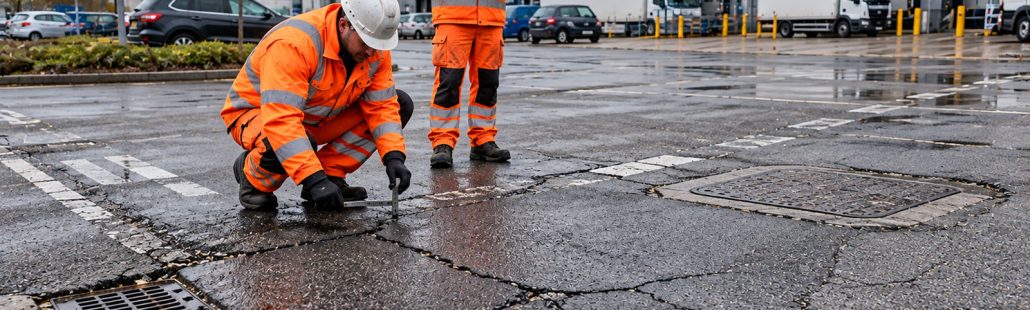
Commercial car parks, industrial yards and access roads face the same principle on a smaller scale. If water repeatedly collects on a road, the problem may involve surface levels, drainage capacity or settlement beneath the pavement rather than the wearing surface alone.
What About the Area Where Aircraft Park?
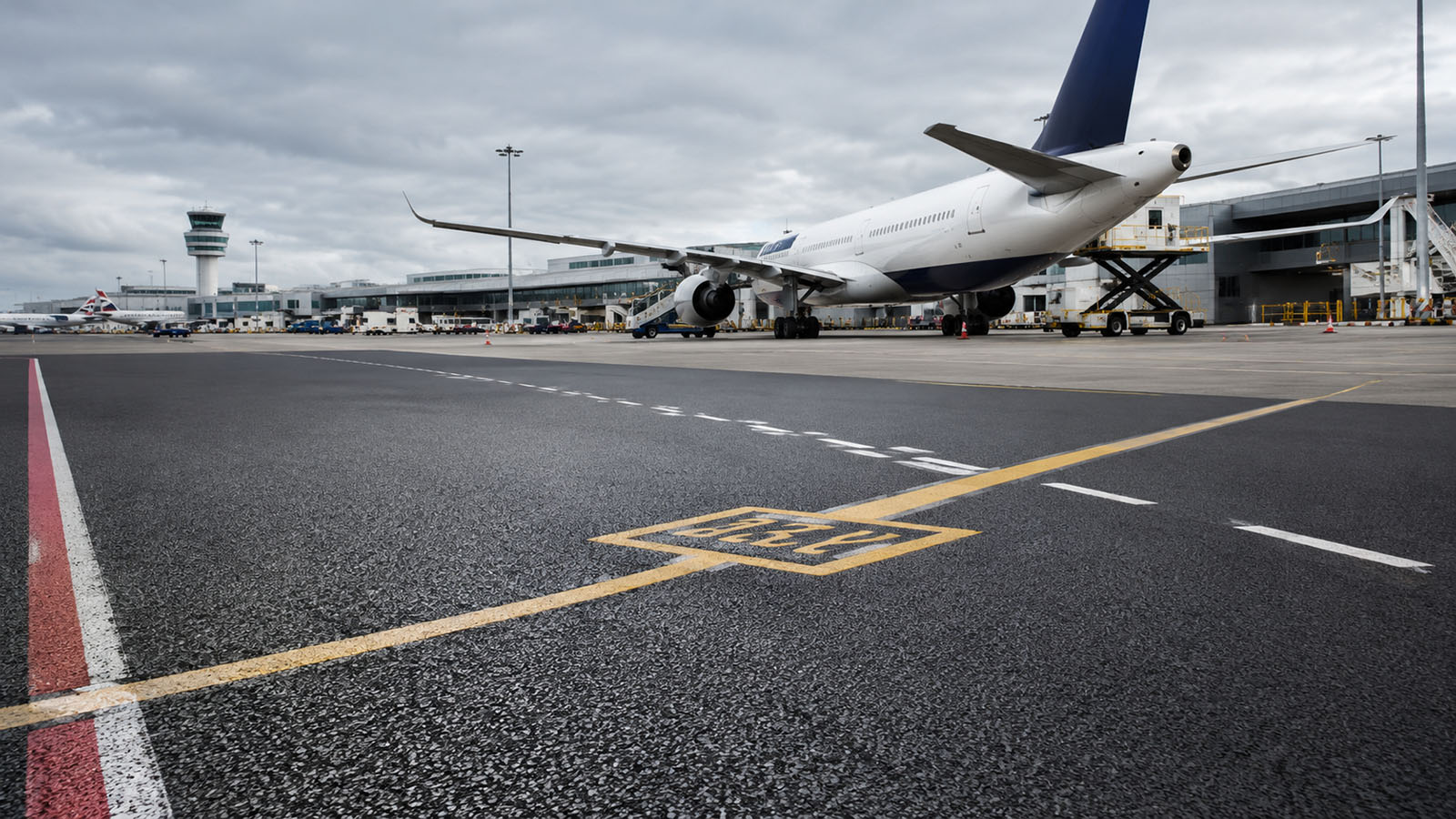
The paved area where aircraft park, load passengers and cargo, refuel and receive servicing is generally known as the apron.
These areas experience a different pattern of loading from runways.
An aircraft may remain stationary for extended periods, concentrating substantial weight through its landing gear. Vehicles and ground-support equipment also move around the aircraft, while turning and manoeuvring create additional pavement stresses.
Depending on the airport and application, rigid pavement such as concrete can be particularly useful in areas requiring high resistance to concentrated loads and certain operational conditions.
This is one reason describing every airport pavement simply as “tarmac” overlooks how specialised these surfaces really are.
Taxiways Have Their Own Demands
Taxiways connect runways with terminals, aprons, hangars and other airport areas.
Aircraft move more slowly here, but the pavement still carries extremely high loads. Junctions and turning locations can be particularly demanding because tyres apply additional forces while the aircraft changes direction.
That is remarkably similar to what happens in a commercial yard.
HGV turning areas, loading bays and entrances often deteriorate faster than straight sections because heavy tyres are braking, accelerating or turning repeatedly in the same location.
Professional commercial surfacing therefore needs to consider vehicle behaviour as well as the number of vehicles using the site.
Why Asphalt Is Still Important
The fact that airport “tarmac” is not necessarily tarmac does not mean black flexible pavement has disappeared.
Asphalt remains an important pavement material because it can provide a strong, smooth and maintainable surface when correctly specified and constructed.
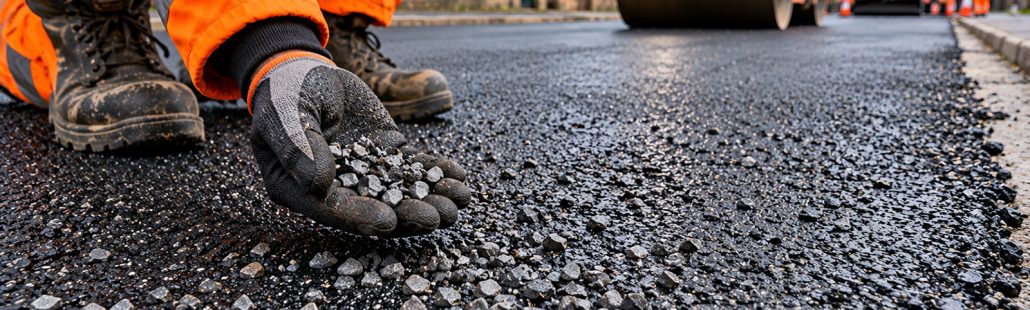
Modern asphalt consists principally of graded aggregates combined with a bituminous binder. Different mixtures can be designed for different performance requirements.
This ability to alter the pavement specification is important because no single asphalt mixture is ideal for every application.
A domestic driveway, commercial car park, motorway and airport pavement may all look broadly similar from a distance while having very different construction beneath the surface.
Machine Laying Helps Produce Consistency
Large pavement areas require careful control of levels, thickness and material placement.
Mechanical paving equipment can distribute asphalt continuously and consistently before rollers compact the material to the required standard.
The same principle makes machine lay tarmac valuable for larger commercial roads, yards and car parks where uniformity and efficient installation are important.
However, machinery is only one part of a successful project. Base preparation, material selection, temperature control, compaction and drainage still determine how well the pavement performs over time.
Why the Layers Underneath Matter So Much
One of the biggest misconceptions about roads is that their strength comes primarily from the visible black surface.
In reality, pavement performance depends on the complete structure.
If supporting layers move excessively, the surface above them can eventually crack or deform regardless of how good it looked when first installed.
Airport pavement engineering makes this especially obvious because the loads are so extreme. The structure has to distribute those loads effectively rather than expecting a relatively thin surface layer to carry everything by itself.
Commercial property owners can apply exactly the same lesson when planning new roads or resurfacing existing ones.
Why Airports Can’t Simply Patch Everything Forever
Airports require careful pavement maintenance because even small defects can become operational concerns.
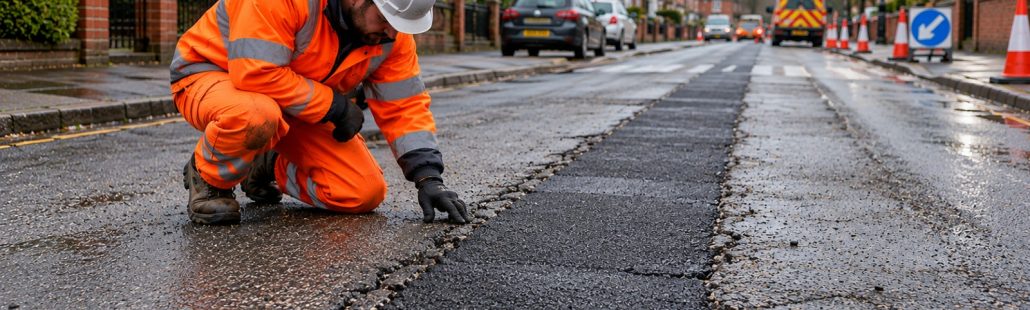
Roads are similar in principle. Local repairs are valuable when damage is genuinely localised, but repeatedly treating the same area can indicate a deeper problem.
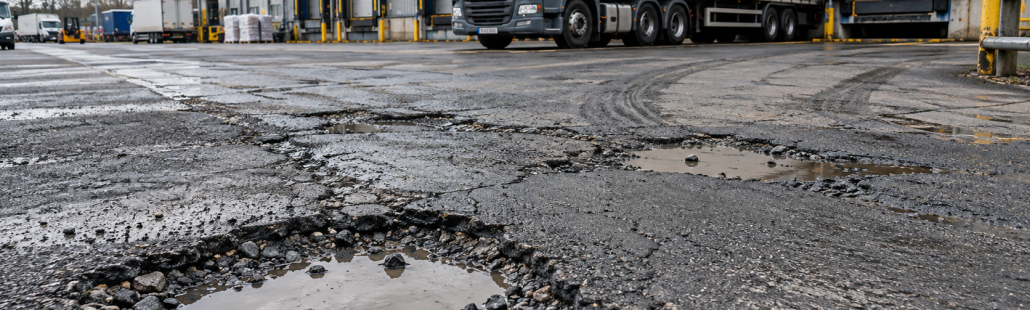
For example, recurring pothole repairs may point towards water ingress, weak supporting layers or repeated heavy loading rather than an isolated surface defect.
Understanding the cause before selecting the repair usually provides better long-term value than repeatedly treating what can be seen from above.
What Airport Pavements Teach Us About Commercial Roads
An airport may seem far removed from an industrial estate, retail park or warehouse access road, but the basic engineering principles have plenty in common.
Both need pavement structures suited to the loads they will carry. Both require effective drainage. Both experience concentrated stresses around braking and turning areas. Both depend on good foundations, appropriate materials and correct installation.
The difference is largely one of scale.
A commercial road does not need to support an airliner, but it still needs to be designed around the HGVs, delivery vehicles, forklifts or cars that will actually use it.
Choosing a surface based solely on appearance or initial price ignores the factors that determine how long it will last.
Is Calling It Airport Tarmac Wrong?
In everyday conversation, not really.
“Tarmac” is widely understood as a general description for paved airport ground, particularly in phrases such as “on the tarmac”. Most people immediately understand what is meant.
From an engineering perspective, however, the term lacks precision.
Different parts of an airport can use different pavement constructions, and modern asphalt itself is technically different from the traditional tar-bound material from which the word tarmac originated.
So the next time someone mentions airport tarmac UK operations, the interesting answer is that the “tarmac” beneath an aircraft may actually be a highly engineered asphalt or concrete pavement designed for a very specific purpose.
The Surface Is Only the Beginning
Airport pavements demonstrate something that applies to almost every road: the visible surface tells only part of the story.
Runways, taxiways and aprons are designed according to their individual loads, movements, drainage requirements and operational demands. The material at the top works because the entire structure beneath it has been designed to support it.
The same approach matters when constructing a commercial access road, car park or industrial yard. A suitable surface, strong foundation, effective drainage and correct installation all need to work together.
That is ultimately why airport “tarmac” is such an interesting example. What looks like a simple expanse of black pavement is actually an engineered system, and the principles behind it are the same ones that separate a long-lasting road from one that fails prematurely.