
- Minisgreat
- No Comments
- September 9, 2026
Why Are Some Roads Red Instead of Black?
Most people associate roads with one colour: black.
Traditional asphalt gets its familiar dark appearance largely from bitumen, the binder used to hold the aggregate within the material together. As the surface ages and is exposed to traffic and weather, it can gradually become lighter and greyer.
But travel through almost any UK town or city and you are likely to encounter sections of road that look completely different.
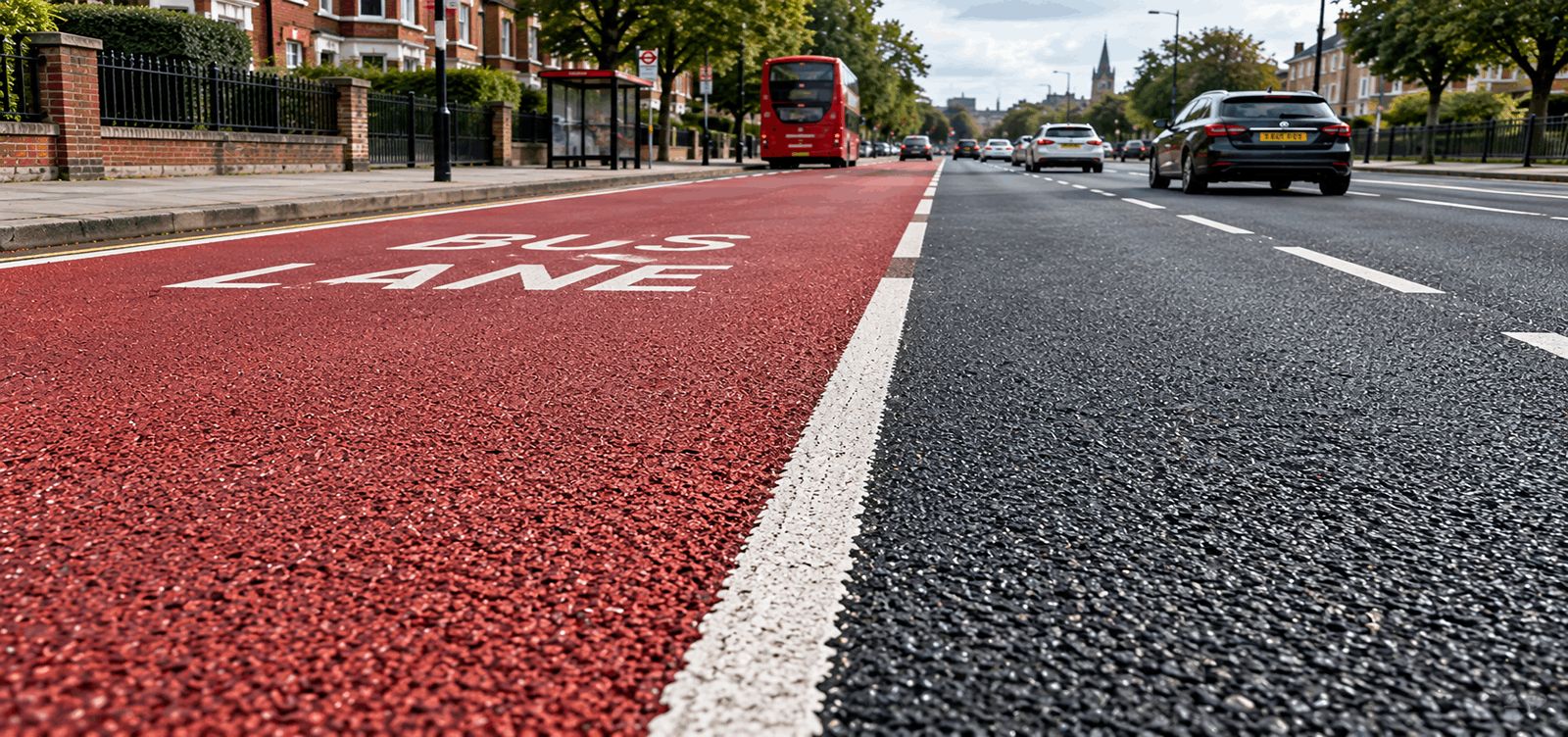
Red surfacing commonly appears around bus lanes, cycle routes, junctions and other locations where highway designers want one part of the road to stand out from another.
It is rarely there simply for decoration.
Red road surfacing UK schemes generally use colour as a visual tool, helping drivers and other road users recognise that a particular part of the carriageway has a different purpose or requires additional attention.
Red Roads Aren’t Usually Made From a Completely Different Type of Road
Seeing a red road can give the impression that an entirely different pavement construction has been used.
That is not necessarily the case.
The structural road underneath may be constructed using conventional pavement layers, with the coloured element forming part of the upper surface or an additional treatment applied over it.
The exact system depends on the project specification and intended purpose.
This distinction matters because colour itself does not provide the structural strength of a road. The foundation, asphalt layers, compaction and drainage underneath still need to perform properly.
Professional tarmac installation therefore depends on far more than the final colour visible to drivers.
Why Is Red Such a Popular Colour?
Red creates a strong visual contrast against conventional dark asphalt.
That makes it useful where road designers want drivers to recognise a change in how a section of carriageway should be used.
Imagine approaching a busy junction where several lanes, crossings and road markings compete for attention. A clearly contrasting surface can help distinguish a particular area from the surrounding carriageway.
The same principle applies to bus and cycle infrastructure.
Rather than relying exclusively on painted markings, a larger area of coloured surfacing provides an additional visual cue.
Red Surfacing Is Commonly Associated With Bus Lanes
One of the most familiar uses of red road surfacing in the UK is highlighting bus lanes.
The coloured surface can help make the lane visually distinct from the general traffic lanes next to it.
This can be particularly useful around busy urban routes where drivers need to identify lane arrangements quickly.
However, drivers should not assume that the colour alone determines the legal restrictions applying to a lane. Road signs and markings remain important because restrictions can vary between locations.
The red surface primarily improves visual differentiation.
Cycle Infrastructure Can Also Use Coloured Surfacing
Cyclists frequently encounter coloured sections around junctions, crossings and cycle lanes.
Again, the purpose is visibility.
A contrasting surface can make a cycle route more obvious where it interacts with other traffic movements.
This is particularly valuable at locations where drivers may be turning across an area used by cyclists.
The change in colour provides an additional visual signal that the road environment has changed and deserves attention.
Why Not Just Use Road Markings?
White lines and road symbols are essential parts of the highway environment, but they occupy relatively limited areas.
Coloured surfacing can cover a much larger section.
That makes the change difficult to overlook.
A driver approaching a substantial red area sees the visual difference before reaching individual markings painted within it.
Colour and road markings can therefore work together rather than performing exactly the same function.
Red Surfacing Can Highlight Conflict Areas
Some parts of the road network involve several different traffic movements crossing or merging.
Junctions are an obvious example.
Vehicles may be braking, turning and accelerating while cyclists and pedestrians use nearby routes. In these situations, road layout needs to communicate clearly with everyone approaching the area.
Coloured surfacing can be used to emphasise a particular zone or route through that more complicated environment.
The objective is to make the road easier to interpret.
Is the Red Colour Mixed Into the Surface?
There is more than one way of producing coloured road surfacing.
Depending on the system and specification, colour may come from selected aggregates, pigments, binders or specialist surface treatments.
Some applications form an integral coloured surface, while others involve a treatment applied to an existing pavement.
This is why two red roads do not necessarily look identical.
One may have a deeper, more consistent colour while another appears more like a conventional road with a coloured treatment over its surface.
Age and traffic also affect the final appearance.
Why Do Some Red Roads Look Faded?
A freshly installed coloured surface can be extremely noticeable.
After years of vehicles passing over it, the appearance may change.
Traffic introduces continuous tyre wear, while dirt, road contamination and weather exposure can affect how strongly the colour is perceived.
The surface may therefore become duller with age.
This does not automatically mean the entire pavement has failed structurally.
Appearance and structural condition are related aspects of road maintenance, but they are not the same thing.
A faded coloured surface can still be structurally sound, while a brightly coloured surface can still experience problems if the pavement underneath is weak.
Heavy Traffic Can Wear Coloured Areas Faster
Where coloured surfacing is placed in heavily trafficked locations, it has to withstand the same demanding forces as the road around it.
Bus lanes are a good example.
Buses are heavy vehicles that repeatedly follow similar wheel paths. They brake at stops, remain stationary while passengers board and accelerate away again.
Junctions create additional turning and braking forces.
As a result, coloured areas in these locations can experience substantial mechanical wear.
Professional commercial surfacing similarly needs to consider how vehicles will move across a surface, because traffic behaviour can be just as important as the total number of vehicles.
Colour Doesn’t Prevent Rutting or Cracking
It is important not to confuse a specialist appearance with immunity from ordinary road deterioration.
A red surface can still crack.
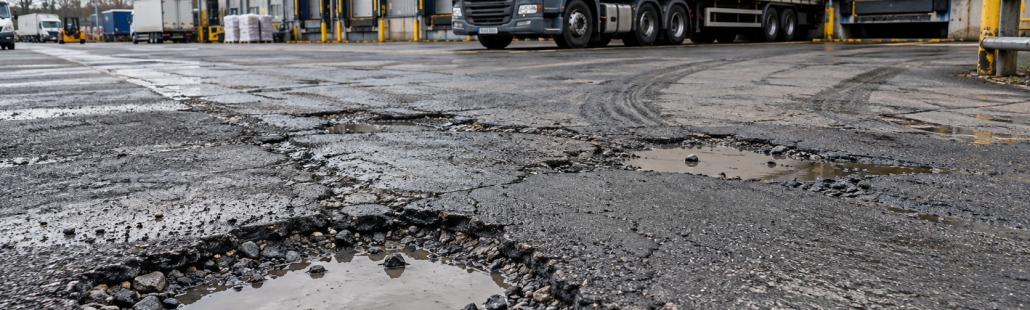
It can still develop wheel ruts, potholes and localised settlement if the underlying pavement is inadequate or deteriorates.
The structural principles remain the same as they do for conventional black asphalt.
Vehicle loading needs to be supported by suitable pavement layers. Water needs to drain effectively. Materials need to be installed and compacted correctly.
If those fundamentals are wrong, changing the surface colour will not solve the problem.
The Foundation Underneath Still Does the Heavy Work
The most important parts of many roads are completely invisible once construction has finished.
Under the surface are structural layers that distribute vehicle loads into the ground.
These layers are especially important where coloured surfacing is used in heavily trafficked bus or traffic lanes.
A high-quality specialist surface installed over an unstable foundation can still move.
Once the pavement underneath begins deforming, the coloured layer above can crack or distort with it.
This is why good surfacing begins with understanding the complete road construction rather than focusing only on the uppermost finish.
Can Red Surfacing Improve Grip?
Some coloured surfacing systems can be specified with particular surface characteristics, including enhanced skid resistance where required.
This can be useful at locations where vehicles regularly brake, turn or change direction.
However, it would be misleading to assume that every red road automatically provides greater grip simply because it is red.
Colour and skid resistance are separate characteristics.
Performance depends on the materials and system selected for the specific application.
Why High-Stress Areas Need Careful Installation
Junctions, bus lanes and approaches to crossings can place considerable demands on a surface.
Vehicles are not simply travelling steadily forwards.
They may brake hard, turn their wheels while moving slowly and accelerate repeatedly from the same positions.
These actions introduce horizontal as well as vertical forces.
The surfacing needs to withstand those demands without separating, deforming or deteriorating prematurely.
Where asphalt is being installed across larger areas, professional machine lay tarmac can help achieve controlled placement, thickness and compaction.
The correct installation method still needs to be combined with an appropriate specification for the location.
Why Repairs Can Look Different Afterwards
Road repairs often create visible patches, and this can be particularly noticeable on coloured surfaces.
If part of the pavement needs excavation for utility work or structural repair, reinstating the area involves more than simply restoring the road level.
The appearance of the specialist surface may also need to be recreated.
Differences in material age, aggregate and surface treatment can mean repaired areas remain visible for some time.
This does not necessarily indicate poor structural performance. Matching an aged road surface perfectly can be difficult even when the repair itself has been carried out correctly.
What Happens When a Pothole Forms in a Coloured Area?
The cause of the pothole still needs to be considered.
A coloured road surface can deteriorate because of cracking, water ingress, traffic loading or weakness within the pavement underneath, just like conventional asphalt.
Simply restoring the colour would not address the structural defect.
Professional pothole repairs need to deal with unstable material and restore the affected pavement appropriately before the final appearance is considered.
Function comes before colour.
Why Aren’t Entire Road Networks Coloured?
If coloured surfacing is useful for visual communication, it might seem logical to colour entire roads.
Doing so could reduce its effectiveness.
Contrast works because the coloured area is different from its surroundings. If every section of road used the same striking colour, that visual distinction would disappear.
Using coloured surfacing selectively allows it to draw attention to specific lanes, routes or locations.
There are also practical considerations involving installation, maintenance and project cost.
Conventional asphalt remains an effective solution for the majority of general road surfacing.
Coloured Surfacing Can Be Used on Private Sites Too
The concept is not limited to public highways.
Commercial sites can use contrasting surface treatments to help distinguish particular areas, depending on the design and specification.
Large car parks, industrial premises and distribution facilities often need clear traffic management because cars, vans, HGVs and pedestrians may all share the same site.
Different surface finishes can form part of that overall layout.
However, colour should not compensate for poor pavement design.
Areas carrying heavy vehicles still need a construction capable of handling those loads.
Surface Condition Matters More Than Colour
A road can be red, black or another specified colour and still require the same fundamental maintenance attention.
Cracking deserves investigation. Standing water can indicate changing levels or drainage problems. Rutting may suggest deformation within the asphalt or deeper pavement layers.
Loose or deteriorating material should not be ignored simply because the specialist colour remains visible.
Site managers should therefore assess the physical condition of the pavement rather than judging it solely by appearance.
Red Roads Are Designed to Communicate
The next time you encounter a red section of road, there is usually a practical reason it looks different from the black asphalt around it.
Red road surfacing UK schemes can make bus lanes, cycle infrastructure and other selected areas more visually distinct, helping road users recognise changes in the highway environment.
The colour itself, however, is only the visible part of the system.
Underneath it, the same fundamental principles of road construction still apply. The pavement needs stable foundations, appropriate materials, effective drainage and sufficient strength for the vehicles using it.
That is why a red road should not simply be thought of as black tarmac with a different appearance.
Its colour has a communication purpose, while the engineering beneath it still determines how well the road actually performs.