
- Minisgreat
- No Comments
- September 5, 2026
Why Are Roundabouts So Hard on Road Surfaces?
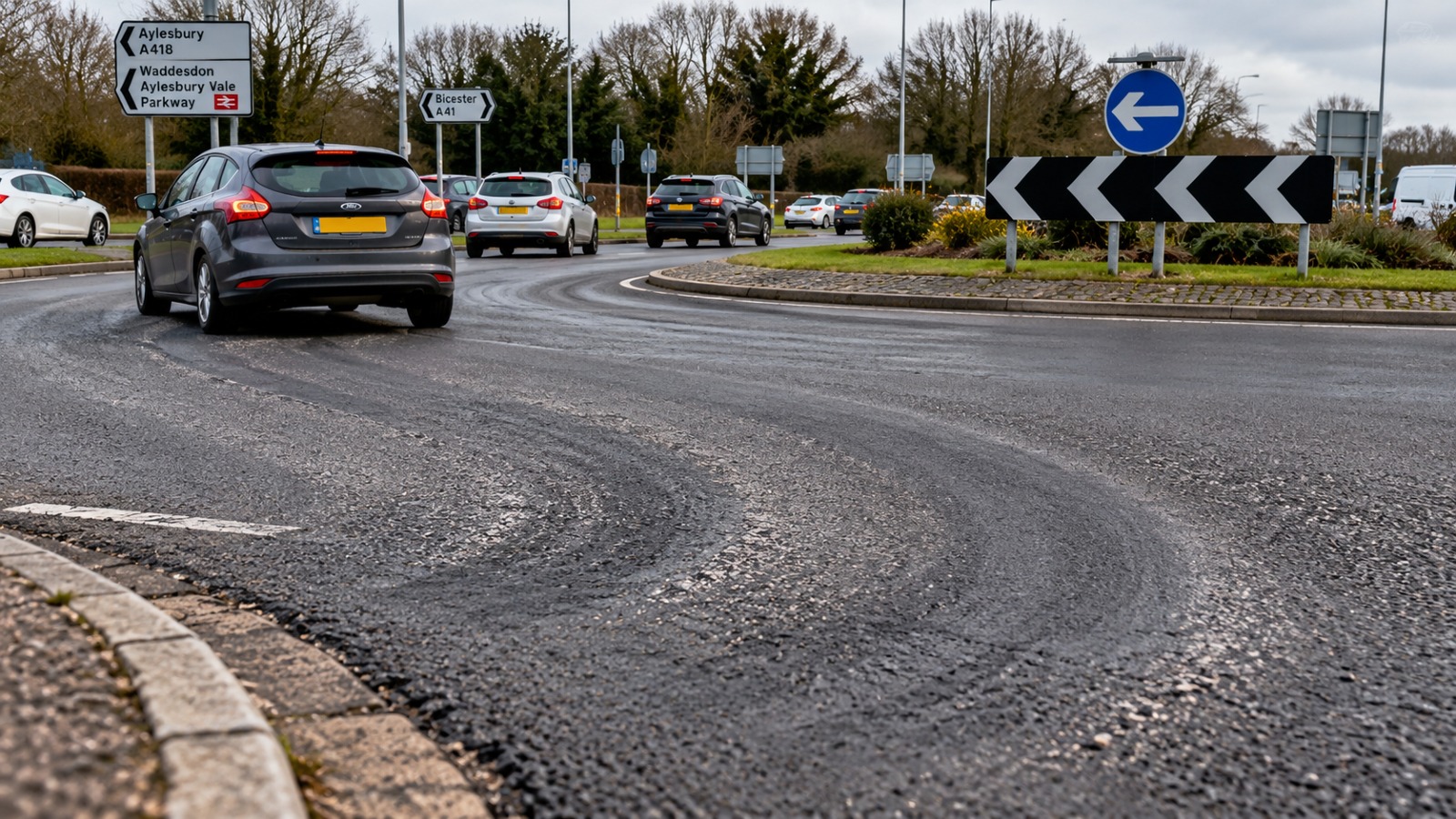
Roundabouts are designed to keep traffic moving efficiently, but from a road surfacing perspective they create a demanding environment.
On a straight section of road, most vehicles travel forwards with relatively limited steering input. Their tyres predominantly apply vertical loads as they roll across the surface.
A roundabout changes that completely.
Vehicles brake as they approach, turn as they enter, remain under continuous steering while travelling around the carriageway and then accelerate as they leave. Heavy vehicles may also scrub their tyres across the surface as multiple axles negotiate the curve.
All of these movements introduce forces that are less pronounced on a typical straight road.
This is why roundabout road surface damage UK drivers and site managers notice can develop even when nearby sections of the same road remain in relatively good condition.
Tyres Are Constantly Turning on a Roundabout
The most obvious difference between a roundabout and a straight road is the amount of steering involved.
As a vehicle follows the circular carriageway, its tyres continually change direction. This generates lateral forces between the tyre and road surface.
The asphalt therefore has to resist more than the downward weight of the vehicle.
It also needs to withstand sideways forces.
A single car travelling around a roundabout does not present a significant problem for a correctly designed road. The challenge comes from thousands of vehicles repeating the same movement every day.
Over years of service, those repeated forces can contribute to surface wear and deformation.
Heavy Vehicles Create Much Greater Turning Forces
HGVs, buses and other large commercial vehicles make the situation considerably more demanding.
Their greater weight increases the load being transferred into the pavement. Their length and axle arrangement also mean the tyres cannot all follow precisely the same path around a tight curve.
Some tyres therefore experience significant lateral scrub.
This is particularly noticeable on smaller roundabouts where large vehicles need to make relatively tight turns.
The combination of vehicle weight and sideways tyre forces places substantial stress on the asphalt.
Roads serving industrial estates, distribution centres and other commercial areas need to account for these movements when the pavement is designed. Professional commercial surfacing should consider not only traffic volume but also vehicle type, turning movements and expected loading.
Tyre Scrubbing Can Accelerate Surface Wear
Tyre scrubbing occurs when a tyre is forced partly sideways across the road rather than rolling freely in its natural direction.
Roundabouts create ideal conditions for this.
The effect becomes more significant with vehicles carrying multiple axles because the wheels are effectively being asked to follow different turning radii.
The surface experiences repeated friction and lateral stress.
Over time, vulnerable asphalt may begin losing texture, deforming or showing signs of aggregate deterioration.
Areas receiving the greatest concentration of heavy turning movements may therefore wear noticeably faster than surrounding pavement.
Braking Starts Before Vehicles Reach the Roundabout
The stress does not begin at the give-way line.
Drivers normally reduce speed while approaching a roundabout.
That means the approach lanes experience repeated braking forces, often concentrated in approximately the same locations.
During busy periods, vehicles may brake to a complete stop before moving forward incrementally while waiting for a suitable gap.
This repeated stop-start behaviour creates a much more demanding loading pattern than steady traffic travelling along a straight road.
As a result, deterioration can begin several metres before the roundabout itself.
The Give-Way Line Is a High-Stress Area
The pavement around the entrance to a roundabout experiences an unusual combination of forces.
Vehicles brake while approaching, stop or slow significantly, turn sharply to enter and then accelerate into the traffic flow.
All of this happens across a relatively compact area.
Heavy commercial vehicles amplify the effect because considerably greater loads are being transferred through their tyres.
If the asphalt mixture, pavement thickness or supporting layers are inadequate, the entrance can begin showing deformation earlier than neighbouring sections.
This is why rutting, cracking and surface distortion are frequently concentrated around roundabout approaches.
Acceleration Adds Stress at the Exit
Once drivers leave a roundabout, they generally begin accelerating.
Tyres transfer this acceleration force into the road surface.
The exit therefore experiences another concentrated loading pattern.
Rather than simply rolling steadily across the pavement, vehicles are increasing speed while simultaneously reducing their steering angle.
For heavily trafficked roundabouts, these actions are repeated continuously throughout the day.
The road must therefore cope with braking on the approach, turning around the centre and acceleration on departure.
Roundabouts Concentrate Traffic Into Predictable Paths
Another reason roundabouts suffer is that vehicles tend to follow similar lines.
Although drivers do not position their vehicles identically, traffic lanes naturally concentrate wheel loads within predictable sections of pavement.
Over time, these repeated wheel paths can become visible.
Rutting may develop where the asphalt or supporting structure gradually deforms under traffic.
Once a rut forms, subsequent vehicles continue following approximately the same path, placing additional stress on the already affected section.
The problem can therefore become progressively more noticeable.
Rutting Can Quickly Create Drainage Problems
A roundabout surface is designed with carefully controlled levels so rainwater can reach gullies and drainage systems.
Rutting changes those levels.
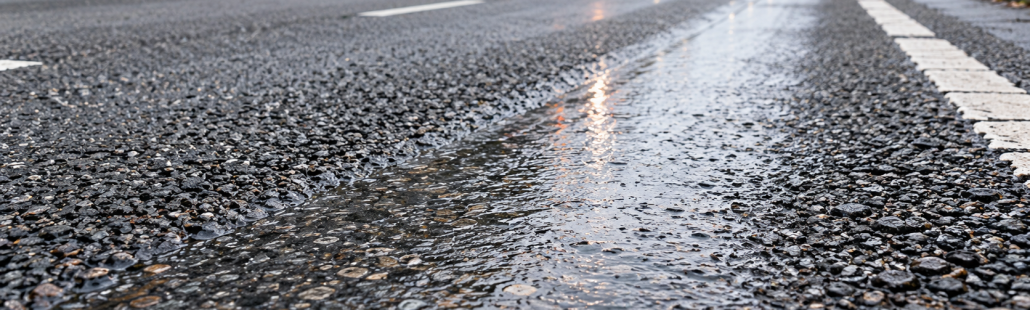
A shallow wheel-track depression may begin trapping water rather than allowing it to drain away.
Initially, this may simply appear as a puddle after rainfall. However, persistent standing water around an already stressed pavement can contribute to further deterioration if cracks or other defects are present.
The problem then becomes more than surface deformation.
Traffic creates the rut, the rut collects water and the water can accelerate deterioration within vulnerable areas.
HGVs Can Push and Distort Asphalt
Heavy vehicle loading does not always result in straightforward cracking.
In some circumstances, asphalt can begin to deform.
The surface may appear pushed, rippled or slightly wavy, particularly where vehicles repeatedly brake and turn.
Roundabouts can create exactly these conditions.
Large vehicles approach under braking, make a substantial steering input and then accelerate. If the pavement materials cannot adequately resist those forces, gradual displacement can occur.
The resulting distortion may eventually affect ride quality and drainage as well as the appearance of the road.
Hot Weather Can Increase the Challenge
UK summers are not consistently hot, but road surfaces can still reach high temperatures during periods of strong sunshine.
As asphalt temperatures rise, the material can become more susceptible to deformation under heavy loading.
A heavily trafficked roundabout may therefore experience particularly demanding conditions during warm weather.
Heavy vehicles continue braking and turning while the pavement is at an elevated temperature, potentially increasing the risk of permanent deformation where the construction is already vulnerable.
Correct material specification is important in locations exposed to these concentrated stresses.
Cold and Wet Conditions Create Different Problems
Winter introduces another set of challenges.
Existing cracks allow water to enter vulnerable areas of pavement. Repeated rainfall keeps surfaces wet, while colder temperatures can place additional stress on already deteriorating construction.
Roundabouts are particularly vulnerable because the road may already contain localised deformation from traffic loading.
Once cracks, ruts and drainage problems begin interacting, deterioration can accelerate.
Maintaining drainage and repairing defects before they become extensive is therefore particularly important in these high-stress locations.
Multi-Lane Roundabouts Have Complex Loading Patterns
Larger roundabouts can experience additional wear because traffic movements are more complicated.
Vehicles may change lanes while travelling around the roundabout, creating further steering forces. Some lanes carry much greater traffic volumes than others depending on the surrounding road network.
Certain sections can therefore deteriorate considerably faster despite being part of the same roundabout.
A visual inspection needs to consider these traffic patterns rather than assuming deterioration should be uniform around the entire carriageway.
The location of damage can often provide clues about the forces responsible.
Small Roundabouts Can Be Especially Tough on HGV Routes
A large roundabout gives long vehicles more space to follow a gradual curve.
Smaller roundabouts require tighter manoeuvres.
For HGVs, this can significantly increase tyre scrub.
Vehicles may also travel close to the edge of the carriageway or use areas designed to accommodate larger turning movements.
Where a small roundabout sits on a route serving warehouses, industrial estates or distribution facilities, pavement design becomes especially important.
The number of vehicles alone does not tell the whole story. A relatively modest volume of heavily loaded HGVs can create substantial concentrated stress.
The Foundation Still Determines Long-Term Performance
Although most visible deterioration occurs at the surface, the asphalt cannot work independently of the layers underneath it.
A strong sub-base helps distribute vehicle loads and maintain the pavement profile.
If the foundation is inadequate or has weakened, repeated heavy turning movements can expose that weakness.
Settlement and rutting may then originate deeper within the road construction.
This is why simply replacing the uppermost surface is not always sufficient when a roundabout has substantial deformation.
Professional tarmac installation needs to consider the complete pavement structure rather than focusing exclusively on the final wearing course.
Why Cracks Often Appear Around Deformed Areas
Once part of the road begins moving, stresses can develop around the affected area.
A rut or distorted section changes how subsequent vehicle loads pass through the pavement.
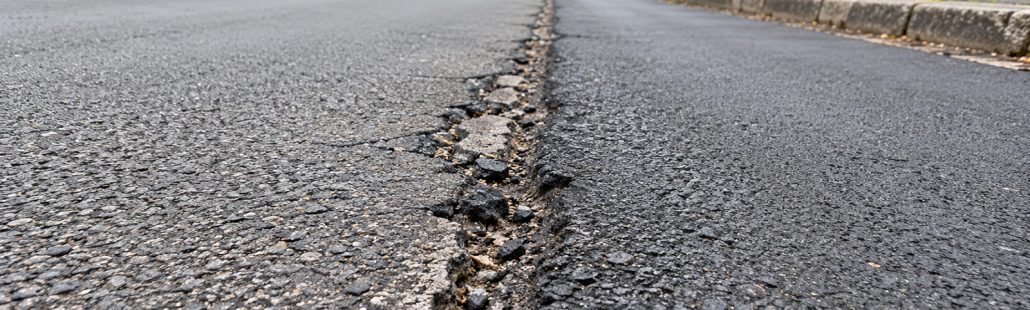
Cracks can then develop along the edges of the deformation.
As traffic continues, those cracks may widen and allow additional water into the pavement.
Eventually, sections of material can begin breaking away.
What initially appeared to be a relatively small deformation can therefore become a more substantial maintenance problem.
Potholes Can Be the Final Stage of Continued Deterioration
Roundabout potholes often develop after earlier warning signs have been present.
Cracking, water ingress and repeated traffic loading gradually weaken the pavement until material begins breaking away.
Once a small hole exists, every passing tyre can place additional impact loading around its edges.
Professional pothole repairs are particularly important in high-traffic locations because a superficial repair may struggle if the surrounding pavement remains structurally weak.
Understanding why the defect formed helps determine how extensive the repair needs to be.
Why Surface Texture Matters on Roundabouts
Road texture contributes to tyre grip, particularly during braking and cornering.
That makes surface condition especially important around roundabouts.
Repeated tyre action can gradually polish aggregate or wear the surface texture in heavily trafficked wheel paths.
Where deterioration becomes significant, wet-weather performance can be affected.
Surface inspections should therefore consider more than cracks and potholes. Changes in texture can also provide useful information about pavement condition.
Good Machine Laying Helps Create a Consistent Surface
Larger road projects benefit from controlled asphalt placement and compaction.
Professional machine lay tarmac can produce consistent levels and thickness across substantial areas, helping the pavement perform as intended.
Roundabouts, however, present practical challenges because their geometry is more complicated than a straight carriageway.
Maintaining appropriate levels, joints and compaction throughout curved sections requires careful planning.
Even a high-quality surface still needs a suitable foundation and specification for the traffic expected to use it.
Repairs Need to Consider Traffic Forces
When the same section of roundabout repeatedly fails, simply replacing damaged asphalt may not solve the problem.
The repair specification needs to consider why that particular area is under greater stress.
Is it directly in the HGV wheel path? Is it an approach where vehicles brake heavily? Is water collecting in an existing depression? Has the foundation underneath started moving?
Answering these questions can reveal why previous repairs have struggled.
A repair that addresses only the visible damage may be subjected immediately to exactly the same forces that caused the original failure.
Commercial Sites Can Have Their Own Mini-Roundabout Problems
Similar conditions occur away from public highways.
Business parks, distribution centres, retail developments and large industrial premises may contain internal roundabouts or circular traffic systems.
These areas can experience repeated HGV movements throughout the working day.
Delivery vehicles may brake at security points, turn tightly around internal junctions and accelerate towards loading areas.
Site managers should therefore pay particular attention to these high-stress locations when inspecting private roads.
A straight access road may remain in good condition while a nearby turning area deteriorates much faster.
Early Maintenance Can Reduce Larger Repairs
Roundabout deterioration often begins gradually.
Slight rutting, small cracks, localised surface polishing or recurring puddles can appear before serious structural damage develops.
These early changes are worth monitoring.
Addressing drainage problems, repairing developing cracks and investigating localised deformation can prevent water and traffic from accelerating deterioration.
Waiting until large potholes form generally means more of the pavement has already been affected.
Roundabouts Demand More From Every Part of the Road
Roundabouts are difficult environments for road surfaces because vehicles rarely behave in a simple, consistent way while travelling across them.
They brake on approach, turn continuously, sometimes stop completely, accelerate on exit and repeatedly follow similar wheel paths.
Heavy vehicles add substantial loads and significant tyre scrub to this pattern.
The resulting roundabout road surface damage UK roads experience is therefore not simply caused by high traffic numbers. It is the combination of vehicle weight, direction changes, braking, acceleration, pavement construction and drainage that determines how quickly deterioration develops.
A well-designed surface needs to account for those forces from the beginning. Where damage already exists, repairs need to address the underlying cause rather than merely replacing the visible asphalt.
That is why a straight road and a roundabout constructed from similar materials can age very differently. The material may be similar, but the demands placed upon it are not.